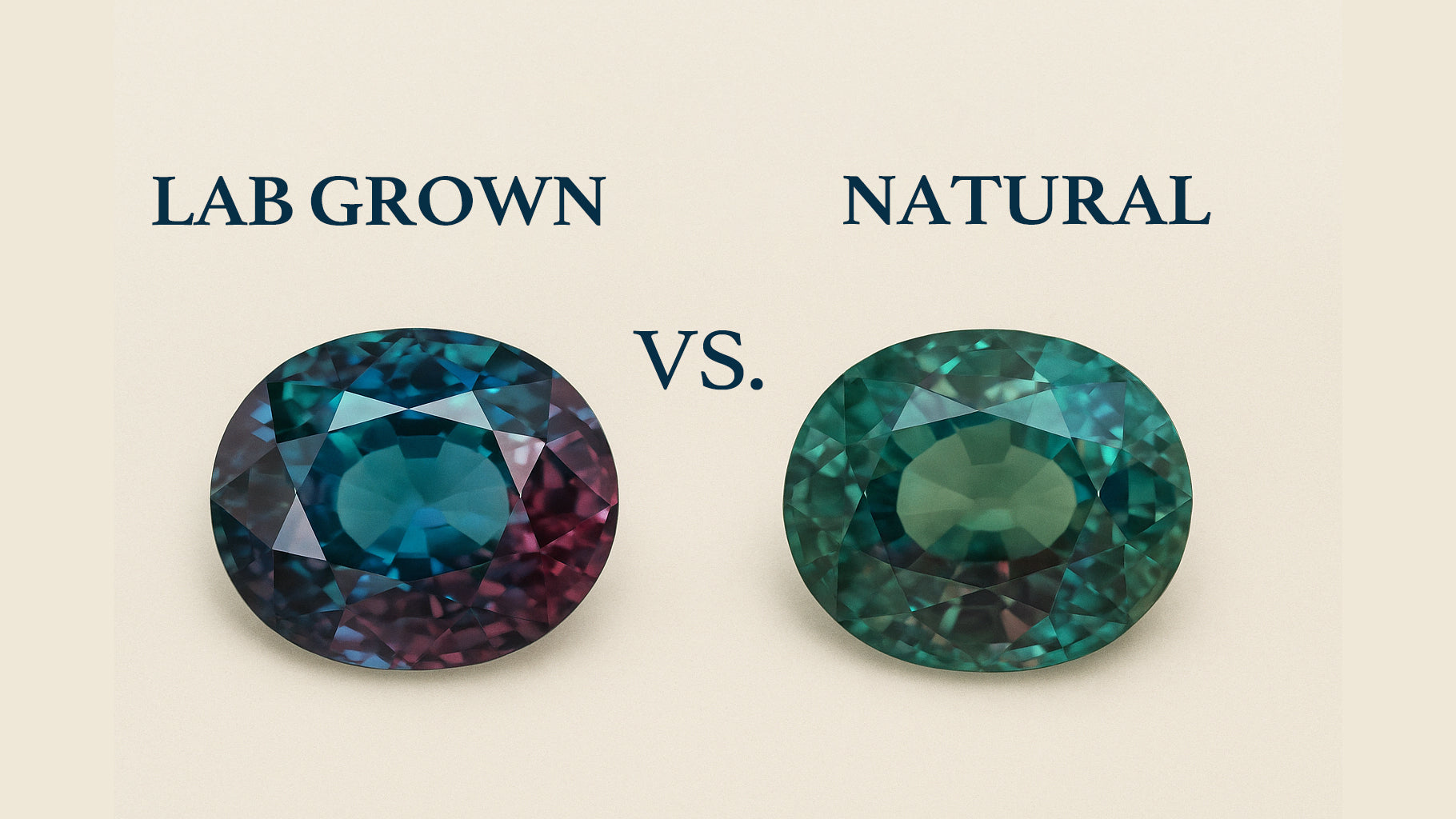
Lab alexandrite's color-change drama and low price point are driving engagement ring buyers to pair it alongside lab diamonds, as seen in real 2026 Reddit posts from brands like Oore.
Why Lab Alexandrite Is Emerging as a Lab-Grown Diamond Alternative: Consumer Adoption Signals from Reddit (2026)
Lab alexandrite is a synthetic gemstone grown in a laboratory to replicate the chemical composition and optical properties of natural alexandrite (chrysoberyl), most notably its striking color change from green or teal in daylight to red or purple under incandescent light. In 2026, real engagement ring buyers on Reddit are increasingly choosing it alongside, or even instead of, lab-grown diamonds.
The signal is subtle but consistent. A post in r/EngagementRings from a newly engaged user reads: "Rings are lab alexandrite and lab diamonds from Oore. I can't stop staring at them both (and the alexandrite color change is incredible). 14k rose gold and size 7.5 for both." That single data point encapsulates a broader trend: consumers who have already accepted lab-grown diamonds as legitimate are now extending that same logic to lab-grown colored gemstones, with alexandrite leading the charge.
This article unpacks why that shift is happening, what lab alexandrite actually is, how it compares to lab diamonds and natural alexandrite, and what it means for anyone shopping for an engagement ring in 2026.
Lab Alexandrite vs. Lab Diamond vs. Natural Alexandrite: How Do They Compare?
Before diving into the "why," it helps to see the core differences side by side. The table below compares lab alexandrite, lab-grown diamonds, and natural alexandrite across the metrics that matter most to an engagement ring buyer.
| Feature | Lab Alexandrite | Lab-Grown Diamond | Natural Alexandrite |
|---|---|---|---|
| Hardness (Mohs) | 8.5 | 10 | 8.5 |
| Color change | Yes — green/teal to red/purple | No (colorless or fancy color, fixed) | Yes — green to red (strongest of all gems) |
| Typical price per carat (1 ct) | ~$50–$300 | ~$800–$2,500 | $5,000–$70,000+ |
| Origin | Lab-grown (Czochralski or flux method) | Lab-grown (CVD or HPHT) | Mined (Russia, Brazil, Sri Lanka) |
| Ethical/environmental claim | No mining required | No mining required | Mined; supply chain varies |
| Availability in engagement rings | Growing rapidly (2024–2026) | Mainstream since ~2018 | Rare; most stones under 1 ct |
| Rose gold compatibility | Excellent (warm tones complement color shift) | Excellent | Excellent |
| Brand availability (2026) | Oore, Brilliant Earth, others | James Allen, Brilliant Earth, Oore, many | Specialty dealers only |
Sources: r/EngagementRings Reddit post, 2026
What Exactly Is Lab Alexandrite, and How Is It Made?
Lab alexandrite is a variety of synthetic chrysoberyl (BeAl₂O₄) that contains trace amounts of chromium, the element responsible for its famous color-change effect. The stone is not an imitation or simulant — it shares the same crystal structure, chemical formula, and refractive index as its natural counterpart. The only meaningful difference is origin: one grew over millions of years in the earth's crust, the other was grown in a controlled laboratory environment over weeks or months.
Two primary growth methods dominate commercial production. The Czochralski (pulling) method involves melting raw materials and slowly pulling a seed crystal upward through the melt, producing large, high-clarity boules. The flux method dissolves ingredients in a molten flux solution and allows crystals to grow slowly over months, often yielding stones with slightly more natural-looking inclusions that some buyers prefer for authenticity. A third method, hydrothermal growth, is less common for alexandrite but produces stones with excellent clarity.
The chromium doping concentration is carefully calibrated during growth to maximize the color-change effect. Poorly calibrated stones may show only a weak shift — from grayish-green to brownish-purple — while well-made lab alexandrite can rival or even exceed the color change of fine natural Russian alexandrite.
At Mohs 8.5, lab alexandrite is harder than most household abrasives and harder than the quartz dust (Mohs 7) that causes most everyday ring scratches. It is softer than sapphire (9) and diamond (10), placing it in excellent company for wearability.
Why Are Engagement Ring Buyers Choosing Lab Alexandrite in 2026?
The Reddit post from r/EngagementRings reflects a convergence of consumer trends building since the mainstream acceptance of lab-grown diamonds around 2018–2020.
The "lab-grown logic" is transferring to colored gemstones. Once a buyer accepts that a lab-grown diamond is chemically and optically identical to a mined diamond, the mental leap to lab-grown colored stones is short. The same ethical argument (no mining), the same value argument (fraction of the natural price), and the same quality argument (controlled growth = fewer inclusions) all apply. Lab alexandrite benefits directly from the consumer education that the lab diamond industry spent years building.
Natural alexandrite is prohibitively expensive and scarce. Fine natural alexandrite with a strong color change commands $5,000 to over $70,000 per carat, making it one of the most expensive gemstones on earth — more expensive per carat than most diamonds. The finest stones come from the Ural Mountains of Russia and are essentially unavailable to the average consumer. Lab alexandrite delivers the same visual drama at $50–$300 per carat, a price reduction of 95–99%. That differential is more dramatic than even lab diamonds versus natural diamonds.
The color-change effect is genuinely spectacular. The Reddit user's comment — "the alexandrite color change is incredible" — captures a real optical phenomenon that draws genuine emotional reactions. In a market where engagement ring buyers increasingly want something unique and conversation-starting, a stone that literally changes color depending on the light source is a powerful differentiator. Lab diamonds, for all their virtues, are optically static.
Rose gold amplifies the effect. The choice of 14k rose gold in the Reddit post is not coincidental. Rose gold's warm copper-pink tones interact beautifully with alexandrite's color-change range. Under daylight, the green/teal contrasts elegantly with the warm metal. Under incandescent light, the stone shifts toward red and purple, which harmonizes with the rose gold's warmth. This pairing has become a recognizable aesthetic in the lab-grown colored gemstone space.
Personalization is driving multi-stone and mixed-gem designs. The engagement ring market in 2026 is defined by personalization. Buyers are moving away from the single-stone solitaire as the only legitimate format. Pairing a lab alexandrite with a lab diamond — as the Reddit user did — creates a ring set that tells a story: the diamond for tradition and brilliance, the alexandrite for personality and color. Brands like Oore are responding by offering both stone types in coordinated settings.
How Does Lab Alexandrite Compare to Other Lab-Grown Colored Gemstones?
Lab alexandrite is not the only lab-grown colored gemstone gaining traction in the engagement ring market. Lab sapphires, lab rubies, lab emeralds, and lab moissanite (technically a diamond simulant, not a colored stone) are all available. Alexandrite stands out because of its color-change effect. No other commercially available lab-grown gemstone offers a dramatic, full-spectrum color shift under different lighting conditions. Lab sapphires come in many colors but do not change. Lab rubies are beautiful but static. Lab emeralds are fragile (typically Mohs 7.5–8) and prone to inclusions. Alexandrite's combination of hardness (8.5), rarity of effect, and now accessibility via lab growth makes it uniquely positioned.
Moissanite deserves separate mention because it has been the dominant lab-grown diamond alternative for over a decade. Moissanite is a silicon carbide gemstone first discovered in a meteor crater, now grown synthetically, with a refractive index higher than diamond (2.65 vs. 2.42) that produces exceptional brilliance and fire. However, moissanite does not change color, and some buyers find its "disco ball" fire effect too intense or artificial-looking. Lab alexandrite appeals to a different buyer: one who wants optical drama rooted in nature rather than extreme sparkle.
For buyers considering which colored lab stone to choose for an engagement ring, the decision often comes down to lifestyle and aesthetic. Lab sapphire is the safe, classic choice. Lab ruby is bold and traditional. Lab alexandrite is the choice for someone who wants a stone that behaves differently every time the light changes — and who is comfortable with a slightly softer stone that requires modest care.
If you are also evaluating traditional lab-grown diamond solitaires, our guide to best lab-grown diamond engagement rings in India (2026) covers ten ranked options across every budget and can help you calibrate what a comparable diamond ring costs.
What Is Oore, and Why Does It Matter for This Trend?
The Reddit post specifically names Oore as the brand supplying both the lab alexandrite and lab diamond rings. Oore is a lab-grown gemstone jewelry brand that has positioned itself as combining lab diamonds and lab-grown colored stones, offering coordinated ring sets that pair both stone types in matching metal settings.
The significance of a brand offering both lab diamonds and lab alexandrite in the same product space is not trivial. It signals that the market has matured enough for a jeweler to build a business around the combination — not as a novelty, but as a core product category. When a brand can sell you a matching engagement ring and wedding band, one featuring a lab diamond and one featuring a lab alexandrite, in the same metal (14k rose gold, size 7.5, as in the Reddit post), it is meeting a real consumer demand, not creating it.
Oore's approach also reflects a broader industry trend: lab-grown gemstone brands are increasingly cross-selling. A customer who comes in for a lab diamond solitaire may leave with a lab alexandrite stacking ring. A customer who discovers lab alexandrite first may add a lab diamond eternity band. The two categories reinforce each other.
Is Lab Alexandrite Durable Enough for an Engagement Ring?
Durability is the first practical question any engagement ring buyer should ask about an unfamiliar stone. For lab alexandrite, the answer is: yes, with appropriate setting and care.
At Mohs 8.5, lab alexandrite is harder than most household abrasives and harder than the quartz dust (Mohs 7) that causes most everyday ring scratches. It is softer than sapphire (9) and diamond (10), so it can be scratched by those materials, but in practice, daily wear on a hand does not regularly expose a ring to sapphire or diamond abrasion.
The more relevant concern for alexandrite is cleavage. Chrysoberyl has imperfect cleavage in one direction, meaning a sharp blow at the right angle could theoretically cause a fracture. This is a lower risk than with emerald (which has poor toughness) but worth noting. A bezel setting or a protective prong arrangement — rather than a fully exposed tension setting — is advisable for an alexandrite center stone in an active lifestyle.
For comparison, lab-grown diamonds have no cleavage planes that matter in practice (they have perfect octahedral cleavage but are so hard that everyday wear poses no risk), making them the most durable engagement ring stone available. Our article on how lab-grown diamonds hold up under daily wear covers real user durability reports in detail, and the contrast with softer colored stones is instructive.
The practical takeaway: lab alexandrite is a legitimate engagement ring stone for most lifestyles, but buyers who work with their hands, frequently handle abrasive materials, or prioritize zero-maintenance durability may prefer a lab diamond as the primary center stone, with lab alexandrite in a protected accent or secondary ring position — exactly the configuration the Reddit user chose.
What Does the Reddit Signal Tell Us About Broader Consumer Adoption?
Reddit's r/EngagementRings is one of the most reliable real-time signals for engagement ring consumer sentiment. Unlike brand marketing or industry reports, it captures what actual buyers are purchasing, wearing, and feeling about their rings. The community has over 400,000 members and generates hundreds of posts per week from people sharing their rings, asking for advice, and reporting their experiences.
The appearance of lab alexandrite in this community — not as a question ("has anyone tried this?") but as a confident, happy reveal post — is meaningful. It suggests that at least a subset of buyers has moved past the consideration phase and into the ownership phase with lab alexandrite. The tone is celebratory and matter-of-fact: the alexandrite is mentioned alongside the lab diamond as an equal partner in the ring set, not as an experiment or compromise.
Consumer adoption of new gemstone categories in the engagement ring market typically follows a predictable arc. First, a small number of early adopters try the stone and post about it online. Then, those posts generate questions and curiosity from a wider audience. Then, brands respond by expanding their offerings. Then, the category achieves mainstream awareness. Lab-grown diamonds followed this exact arc between roughly 2015 and 2022. Lab alexandrite appears to be in the early-to-middle phase of that same arc in 2026.
The specific details in the Reddit post are also worth noting for what they reveal about the buyer profile. The couple chose 14k rose gold (not platinum or yellow gold), suggesting aesthetic sophistication and awareness of current trends. They chose size 7.5, a standard adult ring size. They purchased from a single brand (Oore) for both rings, suggesting they valued a coordinated aesthetic and a simplified purchasing experience. These are not impulsive buyers — they made deliberate, informed choices.
How Should You Think About Lab Alexandrite vs. Lab Diamond for Your Engagement Ring?
The choice between lab alexandrite and lab diamond as a center stone is not a binary one — as the Reddit post demonstrates, many buyers are choosing both. But if you are deciding which stone to prioritize, here is a framework.
Choose a lab diamond as your primary stone if: you want maximum durability (Mohs 10), you prefer a colorless or near-colorless stone that works in any lighting, you want the broadest resale market (though resale value for lab diamonds has declined significantly), or you are buying in a context where diamond is the expected or traditional choice.
Choose lab alexandrite as your primary stone if: you want a stone with genuine visual drama and uniqueness, you are comfortable with Mohs 8.5 hardness and appropriate setting care, you want to spend significantly less for a larger or higher-quality stone, or you want a ring that generates genuine conversation and curiosity.
Choose both if: you want a ring set that combines the brilliance and tradition of a diamond with the color-change magic of alexandrite, you are buying a coordinated engagement ring and wedding band, or you want a ring that looks different in every photo depending on the lighting.
The 14k rose gold setting mentioned in the Reddit post is worth highlighting as a metal recommendation for alexandrite. Rose gold's warmth complements both the green/teal and red/purple phases of the color change, and 14k (58.5% gold) offers a good balance of durability and color saturation. Our guide to curved solitaire engagement rings and how to choose the right band style and metal covers metal selection in depth and is applicable to alexandrite settings as well.
For buyers in India specifically, the lab-grown colored gemstone market is less developed than in the US, but demand is growing. Our roundup of best lab-grown diamond engagement rings in India (2026) provides a baseline for what lab-grown stones cost in the Indian market, and the same pricing logic applies to lab alexandrite as supply chains mature.
What Should You Watch Out for When Buying Lab Alexandrite?
The lab alexandrite market is less regulated and less standardized than the lab diamond market, which means buyer education is essential. Several issues are worth flagging.
Simulants sold as lab alexandrite. Some sellers market color-change synthetic corundum (sapphire) or synthetic spinel as "alexandrite" or "lab alexandrite." These are not alexandrite — they do not have the same chemical composition (BeAl₂O₄) and their color-change mechanisms differ. Genuine lab alexandrite should come with documentation specifying the material as synthetic chrysoberyl. When in doubt, ask for a gemological report from a recognized lab such as GIA, IGI, or AGL.
Weak color change. Not all lab alexandrite is created equal. Poorly grown stones may show only a subtle shift — from grayish-green to brownish-purple — rather than the dramatic green-to-red change that makes fine alexandrite famous. When shopping, ask specifically about the color-change strength and, if possible, view the stone under both daylight-equivalent and incandescent lighting before purchasing. Reputable brands like Oore should be able to provide images or video demonstrating the color change.
Inconsistent grading standards. Unlike diamonds, which are graded on the standardized 4Cs system, colored gemstones including alexandrite do not have a universally adopted grading scale. Terms like "AAA quality" or "top grade" are not standardized and can be used loosely. Focus on the specific color-change description, clarity observations, and carat weight rather than grade labels.
Setting compatibility. Because alexandrite is slightly softer than sapphire, it requires a setting that protects the girdle and table from impact. Prong settings with at least four prongs, bezel settings, and halo settings all work well. Avoid tension settings for alexandrite center stones.
The Bigger Picture: What Lab Alexandrite Means for the Lab-Grown Gemstone Market
The emergence of lab alexandrite as an engagement ring choice is part of a broader democratization of rare gemstones. For most of human history, alexandrite was so scarce and expensive that it was essentially inaccessible to anyone outside the very wealthy. Lab growth has changed that equation completely, just as it changed the equation for diamonds.
This democratization has implications beyond individual purchasing decisions. It challenges the traditional hierarchy of gemstones — in which diamond sits at the top, followed by ruby, sapphire, and emerald — by introducing a stone that, in its natural form, is rarer and more expensive than most diamonds, but in its lab-grown form is accessible to many budgets. A buyer who cannot afford a 1-carat natural alexandrite at $50,000+ can now own a 1-carat lab alexandrite with an equally strong color change for a few hundred dollars.
It also signals that the engagement ring market is genuinely diversifying. The dominance of the colorless diamond solitaire, which was itself a product of 20th-century marketing rather than ancient tradition, is giving way to a broader palette of choices. Lab-grown diamonds, lab alexandrite, lab sapphires, and other synthetic stones are all competing for the same ring finger, and consumers — particularly younger buyers who discovered lab diamonds on Reddit and YouTube — are comfortable making those choices based on their own aesthetic preferences rather than inherited norms.
For anyone tracking the lab-grown gemstone space, the Reddit post from r/EngagementRings is a small but telling data point. A happy couple, two rings, one lab diamond, one lab alexandrite, both from Oore, both in 14k rose gold. That combination would have been unusual five years ago. In 2026, it is the kind of post that gets upvotes and comments asking "where did you get those?" — which is exactly how consumer trends spread.
Practical Buying Checklist for Lab Alexandrite Engagement Rings
For buyers ready to explore lab alexandrite, the following checklist covers the key decisions:
- Confirm the stone is synthetic chrysoberyl, not color-change synthetic corundum or spinel. Ask for documentation.
- Evaluate the color change under both daylight and incandescent light before purchasing. Strong color change (green/teal to red/purple) is the primary quality indicator.
- Choose a protective setting — four-prong or more, bezel, or halo — to protect the stone's edges.
- Select 14k or 18k rose gold or yellow gold for maximum visual harmony with the color-change range. White gold and platinum work too but create a cooler aesthetic.
- Pair with a lab diamond if you want maximum brilliance and durability in the set, using the alexandrite as the color accent or secondary stone.
- Buy from a brand with transparent sourcing, such as Oore, which supplies both lab diamonds and lab alexandrite in coordinated settings.
- Budget realistically: a quality 1-carat lab alexandrite should cost $100–$500 depending on color-change strength and clarity. Prices significantly below this range may indicate a simulant.
For buyers who want to explore the full range of lab-grown diamond ring styles before committing to a mixed-gem approach, our guides on 1.5 to 2 carat oval lab-grown diamond solitaire rings and best two-stone yellow and white pear diamond engagement rings provide useful context for what coordinated multi-stone designs look like in the lab-grown space.
The lab alexandrite trend is real, it is consumer-driven, and it is accelerating. The question for 2026 buyers is not whether lab alexandrite is a legitimate choice — it clearly is — but whether its particular combination of color-change drama, accessible pricing, and rose gold compatibility matches what they want from a ring they will wear every day.
Sources
- Engaged and so happy — r/EngagementRings Reddit post (2026)
- Best Lab-Grown Diamond Engagement Rings to Buy in India (2026): 10 Picks Ranked Across Every Budget
- How Lab-Grown Diamonds Hold Up Under Daily Wear: Real User Durability Reports
- Curved Solitaire Engagement Rings: How to Choose the Right Band Style, Metal, and Fit
- 1.5 to 2 Carat Oval Lab-Grown Diamond Solitaire Rings: What to Know Before Buying in India (2026)
- Best Two-Stone Yellow and White Pear Diamond Engagement Rings to Buy in 2026