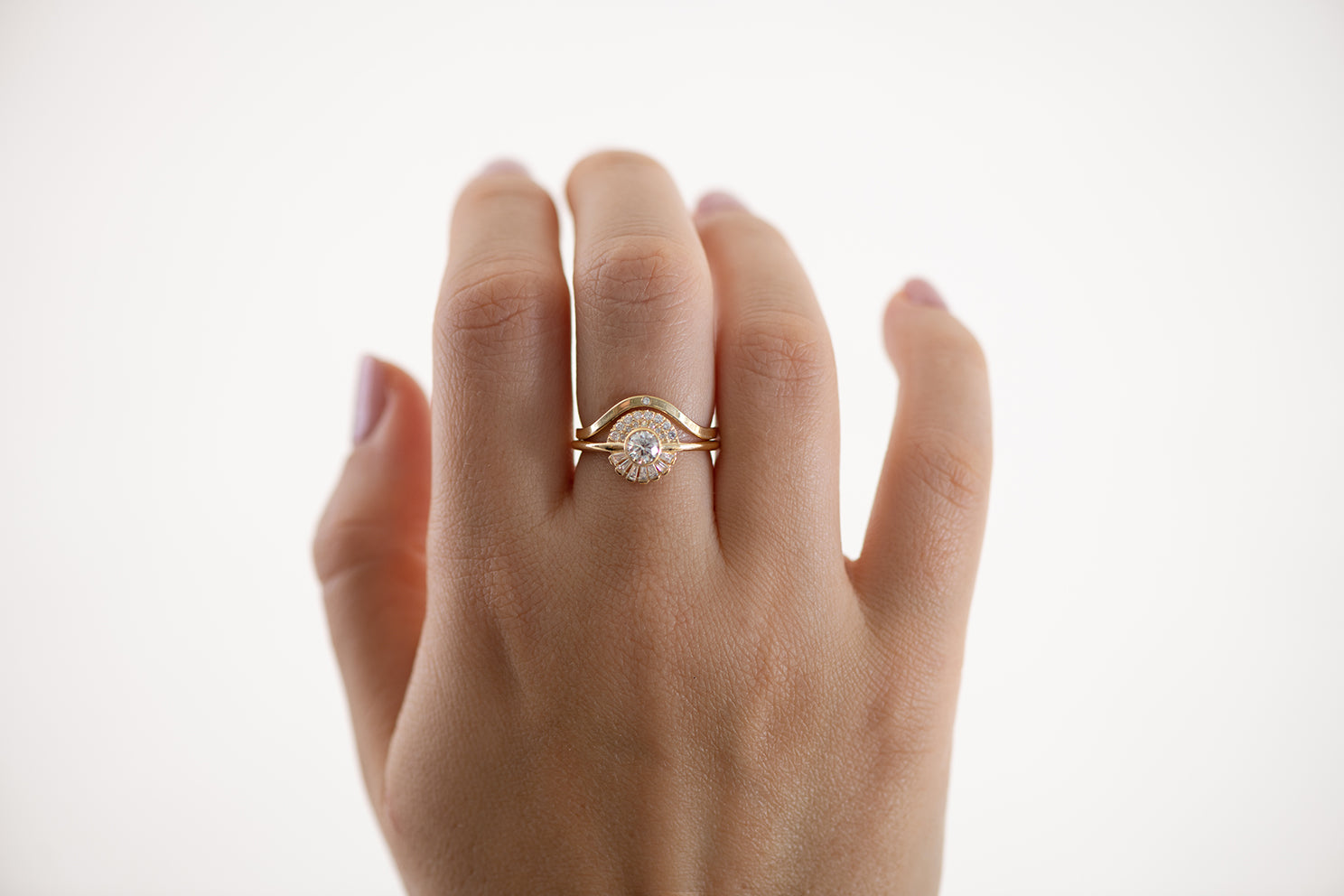
Curved Solitaire Engagement Rings: How to Choose the Right Band Style, Metal, and Fit
Curved solitaire engagement rings feature an arced band that hugs the center stone; the main choice is between an integrated curved-band solitaire and a separate contoured band added to an existing ring.
A curved solitaire engagement ring features a band that follows an arc or contour rather than a straight horizontal line, allowing the metal to nestle flush against the center stone and eliminate the gap that commonly appears when a straight-banded solitaire is worn alongside a wedding band. The style has moved from a niche bridal preference into one of the most requested engagement ring silhouettes of 2026, and the range of options — from fully integrated one-piece designs to stackable add-on contour bands — means the buying decision is more detailed than it first appears.
Before diving into the individual design categories, here is a side-by-side look at five distinct approaches to the curved solitaire, drawn from current market offerings:
| Feature | Curved V Cushion Diamond Solitaire Ring – True Diamond | Solitaire Ring with Curved Wedding Band – Fascinating Diamonds | Contoured Diamond Wedding Ring – Rare Earth Jewelry | Solitaire Curved Diamond Engagement Ring – Temple & Grace | Round Solitaire Engagement Rings – Brilliant Earth |
|---|---|---|---|---|---|
| Band type | Integrated V-shaped curved band (one-piece ring) | Separate curved wedding band designed to complement a solitaire | Contoured add-on band with pavé diamonds | Integrated curved band with solitaire setting | Curved and straight band options available |
| Diamond/stone | Cushion-cut lab diamond | Not disclosed (band sold separately) | Pavé diamonds along the curvature | Diamond solitaire (shape not disclosed) | Round brilliant; lab-grown or natural |
| Metal options | 14KT or 18KT; yellow, rose, or white gold | Multiple metal options | Not disclosed | Not disclosed | Multiple metals; extensive customisation |
| Size range | 16 Indian sizes (sizes 7–22) | Not disclosed | Not disclosed | Not disclosed | Not disclosed |
| Starting price | From approx. ₹84,547 | Not disclosed | Not disclosed | Not disclosed | Not disclosed |
| Market / region | India | International | International | UK | International |
| Best for | Integrated V-band cushion solitaire in multiple gold types | Pairing a separate curved band with an existing solitaire | Diamond-accented contoured band to frame a round solitaire | Classic curved solitaire with a refined UK-market finish | Ethically sourced solitaires with extensive customisation |
What exactly is a curved solitaire engagement ring, and how does it differ from a straight-band solitaire?
In a curved solitaire engagement ring, the band itself is shaped — typically arcing upward toward the center stone or dipping into a V or U profile — so that the metal wraps around the setting rather than passing beneath it in a flat line. The practical consequence is that the ring sits flush against adjacent bands without leaving a visible gap at the sides of the stone.
Straight-band solitaires are the historical default. They are clean, versatile, and easy to resize. But when worn alongside a wedding band, a straight solitaire often creates a small but noticeable space on either side of the setting — a gap that many wearers find visually incomplete. Curved engagement rings solve this problem by contouring the band to the shape of the setting, so the two rings read as a unified piece.
Three main structural types merit understanding before you shop:
Curved solitaire (integrated design): The band and the stone setting are manufactured as a single ring. The curve is built into the shank, not added later. This approach offers the most visual cohesion and removes any worry about future band compatibility.
Contour or shaped band (add-on): A separately purchased band, curved to hug a specific solitaire profile. This gives flexibility — you can keep an existing solitaire and add the curved element at engagement or at marriage. The fit depends on how closely the contour matches the original ring's setting height and width.
Bypass style: The band ends curve past each other on either side of the stone, creating a crossed or spiral effect. Less common in solitaire contexts but worth knowing as a distinct category.
Buyers who already own a solitaire — or who want to choose the stone and setting independently — benefit from the add-on contour band's flexibility. Those starting from scratch who want a single, architecturally coherent piece typically prefer an integrated curved-band solitaire.
Why are curved solitaire rings becoming more popular in 2026?
The shift toward curved bands reflects a broader change in how people think about jewelry as a system rather than a collection of individual pieces. As bridal jewelry trends have evolved, buyers increasingly think about how an engagement ring and wedding band will look together on the finger from day one — not as an afterthought at the time of marriage.
Several factors are converging to accelerate this:
Stacking culture. The popularity of stacked rings across all jewelry categories has made gap-free fit a genuine priority. A curved solitaire slots naturally into a stack without creating visual interruptions.
Lab-grown diamond adoption. As lab-grown diamonds have made higher carat weights accessible at lower price points, center stones have grown larger on average. Larger stones with taller settings create more pronounced gaps when paired with straight bands, making curved bands proportionally more useful.
Intentional design. Buyers in 2026 research ring architecture more carefully than previous generations. The difference between a ring that looks "assembled" and one that looks "designed" is often the curve of the band, and that distinction is now widely understood.
Social media visibility. The close-up photography that dominates engagement ring content on social platforms makes band-to-setting fit highly visible. Gaps that might be unnoticeable in person are obvious in a flat-lay photograph, which has pushed more buyers toward contoured solutions.
Straight bands remain the most versatile choice for buyers uncertain about future stacking preferences or who prioritize easy resizing. The curved solitaire, however, has moved from a specialty request to a mainstream option.
Do curved bands work with all diamond shapes, or are some shapes better suited?
Compatibility between a curved band and a diamond shape depends primarily on the height and footprint of the setting, not the shape itself. That said, some shapes pair more naturally with specific curve profiles.
Round brilliant: The most universally compatible shape. A gentle arc or V-curve fits cleanly beneath a round setting regardless of prong count. Round solitaires with curved bands are the most common combination in the market, and Brilliant Earth's round solitaire range reflects this by offering both curved and straight band options within the same collection.
Cushion cut: Cushion-cut stones have a softer, rounded square profile that pairs well with V-shaped bands. The V-curve mirrors the angular-yet-soft character of the cushion shape. True Diamond's Curved V Cushion Diamond Solitaire Ring exemplifies this pairing — the cushion-cut stone sits above a built-in V-shaped band, and the two elements are sold as a single integrated ring.
Oval: Oval stones have an elongated footprint that can create a pronounced gap with straight bands. A curved band that rises on both sides of the setting addresses this effectively. Oval lab-grown diamond solitaires are particularly well-served by contoured bands because the stone's length means the gap is more visible at the sides.
Pear and marquise: These pointed shapes require a curved band that accommodates the tip of the stone without pressing against it. A V-notch band works well for pear shapes; a wider arc suits marquise cuts.
Princess and emerald: Square and rectangular step-cut stones have flat sides that sit close to the finger, reducing the gap issue with straight bands. Curved bands still work but are less structurally necessary.
The practical rule: the taller the setting and the more irregular the stone's footprint, the more a curved band improves the overall fit and appearance.
What are the differences between integrated curved-band solitaires and separate contour bands?
This is the central decision for most buyers, and it has implications beyond aesthetics.
Integrated curved-band solitaires are rings where the curve is designed into the shank from the start. The stone, setting, and band are a single manufactured piece. The advantages are visual coherence (no risk of mismatched profiles), structural integrity (no two pieces to keep aligned on the finger), and a cleaner look from every angle. The trade-off is less flexibility: you cannot swap the band later, and resizing can be more complex if the curve is pronounced.
True Diamond's Curved V Cushion Diamond Solitaire Ring exemplifies this category. The cushion-cut lab diamond is set above a curved V-shaped band, and the entire piece is available in 14KT or 18KT gold across yellow, rose, and white gold — with 16 size options covering Indian sizes 7 through 22. The band and stone are not sold separately; the design is conceived as a whole. Starting from approximately ₹84,547, it sits at the accessible end of the fine jewelry market for an integrated design with metal choice flexibility.
Temple & Grace's Solitaire Curved Diamond Engagement Ring similarly presents an integrated curved-band solitaire, positioned for the UK fine jewelry market. Specific metal and sizing details are not disclosed on the product page, but the design philosophy — band and stone as one piece — is the same.
Separate contour bands are purchased independently and worn alongside an existing solitaire. Fascinating Diamonds' Solitaire Ring with Curved Wedding Band takes this approach: the curved band is designed to complement a solitaire engagement ring as a stackable add-on. This suits buyers who already own a solitaire or who want to choose the engagement ring and wedding band from different collections. The fit depends on how well the contour matches the existing ring's profile — a consideration worth raising with the retailer before purchasing.
Rare Earth Jewelry's Contoured Diamond Wedding Ring adds another dimension: pavé diamonds set along the curvature of the band itself. This means the add-on band contributes its own brilliance rather than simply framing the center stone, which changes the visual balance of the stack. It is specifically designed to hug a round solitaire engagement ring, making it a strong choice for buyers who want to upgrade the look of an existing round solitaire without replacing the ring.
The decision framework is straightforward: if you are buying the engagement ring new and want a cohesive design from day one, an integrated curved-band solitaire is the cleaner choice. If you already own a solitaire or want to separate the engagement and wedding ring purchases, a contour band gives you that flexibility — with or without diamond accents depending on your preference.
How does metal choice affect a curved solitaire ring's appearance and durability?
Metal choice in a curved solitaire ring affects three things: color against the skin, structural durability of the band (particularly relevant where the curve is thinnest), and long-term maintenance requirements.
Gold karat: 14KT gold contains approximately 58.3% pure gold alloyed with harder metals, making it more durable and scratch-resistant than 18KT. 18KT gold (75% pure gold) has a richer, deeper color — particularly noticeable in yellow gold — but is marginally softer. For a curved band where the thinnest point of the shank bears repeated stress, 14KT is often the more practical choice for everyday wear, though 18KT remains popular for its color saturation and prestige. Lab-grown diamonds in both karats are widely available, and the choice between them is largely personal rather than technical for most wearers.
Metal color: Yellow gold is the warmest option and tends to complement cushion-cut and oval diamonds by adding a vintage warmth to the overall look. Rose gold has a similar warmth but with a pink-copper tone that suits romantic or vintage-inspired designs. White gold is rhodium-plated to achieve its bright silver appearance and requires re-plating every one to three years as the plating wears — a maintenance consideration that buyers sometimes overlook.
For integrated curved-band solitaires like True Diamond's Curved V Cushion, the availability of all three metal colors in both 14KT and 18KT means the buyer can match the ring to their skin tone and style preference without compromising on the band architecture. This level of metal flexibility is not universal across integrated designs, and it is worth confirming with any retailer before purchase.
Platinum is not covered by the five products in this comparison but is worth noting as a context: it is denser and more durable than gold, does not require plating, and develops a patina over time rather than losing metal. For buyers prioritizing longevity over color flexibility, it is an alternative worth researching separately.
How do you get the fit right for a curved solitaire ring?
Sizing a curved solitaire ring is more involved than sizing a straight-band ring, for two reasons: the band's geometry changes how the ring sits on the finger, and the curve can make resizing more technically complex after purchase.
Finger profile matters. A V-shaped band sits differently on a tapered finger than on a uniform-width finger. Buyers with tapered fingers — narrower at the base, wider at the knuckle — sometimes find that a V-band sits more securely than a straight band because the V's geometry naturally anchors the ring. Buyers with uniform or wider fingers may find the V-shape less comfortable if the angle is sharp.
Half-size increments. Curved bands, particularly those with a pronounced V or U profile, are harder to resize than straight bands because the metalsmith must maintain the curve's geometry while adjusting circumference. Many retailers recommend sizing up by half a size if you are between sizes, to ensure comfortable daily wear without the ring being too tight at the knuckle.
Indian sizing conventions. For buyers in India, ring sizes are typically expressed on a scale of approximately 1–30, with sizes 7–22 covering the majority of adult finger sizes. True Diamond's Curved V Cushion Diamond Solitaire Ring offers 16 size options within this range, which is a broader selection than many integrated curved-band designs. Buyers should measure when fingers are at their largest, and account for seasonal swelling.
Try before you buy. For contour bands purchased as add-ons, it is worth physically trying the combination — engagement ring plus contoured band — before committing. The contour's depth and width need to match the solitaire's profile closely enough that the two rings sit flush without rocking or creating pressure points. House of Williams and similar specialist shaped-ring retailers offer a range of contour depths specifically to accommodate different setting heights, which is a useful reference point when assessing fit.
Which curved solitaire approach suits which type of buyer?
Matching the right design to the right buyer requires thinking about three variables simultaneously: how the ring will be worn day-to-day, what the buyer's existing jewelry situation is, and how much flexibility they want to retain.
The buyer who wants a single, complete piece: An integrated curved-band solitaire is the most appropriate choice. The band and stone are designed together, the proportions are resolved by the manufacturer, and there is no future compatibility question. Temple & Grace's Solitaire Curved Diamond Engagement Ring and True Diamond's Curved V Cushion Diamond Solitaire Ring both fall into this category, with the latter offering explicit metal and size flexibility for the Indian market.
The buyer who already owns a solitaire: A separate contour band is the practical solution. Fascinating Diamonds' curved wedding band is designed precisely for this scenario — it complements an existing solitaire without requiring any modification to the original ring. The buyer retains their original ring's character while gaining the gap-free stacked look.
The buyer who wants diamond accents on the band itself: Rare Earth Jewelry's contoured band with pavé detailing addresses this niche. The diamonds along the curvature add brilliance to the band independently of the center stone, which is particularly effective when the center stone is a modest size and the buyer wants the overall look to feel more substantial.
The buyer prioritizing ethical sourcing and customisation breadth: Brilliant Earth's round solitaire collection offers lab-grown and natural diamond options with strong certification and ethical sourcing documentation, alongside the ability to choose between curved and straight band profiles. This suits buyers for whom the provenance and certification of the diamond are as important as the band geometry.
The buyer on a defined budget in India: Starting from approximately ₹84,547, True Diamond's integrated V-band cushion solitaire provides a complete ring — stone and band — with metal and karat flexibility, which compares favorably to the cost of purchasing a solitaire and a separate contour band independently.
What should you check before buying a curved solitaire ring online?
Buying a curved solitaire ring online introduces specific risks that straight-band purchases do not share to the same degree. The following checks are worth completing before placing an order.
Confirm whether the band and stone are sold together or separately. Product pages for curved rings sometimes show the engagement ring and wedding band as a set in photography but sell them individually. Read the product description carefully and contact the retailer if the listing is ambiguous.
Ask about the resizing policy. Curved bands — particularly V-shaped shanks — are harder to resize than straight bands. Some retailers will not resize a curved band at all after purchase; others charge a premium. Knowing this before you buy is important, especially if you are purchasing as a gift or are uncertain of the recipient's size.
Request the setting height measurement. If you are buying a contour band to pair with an existing solitaire, the setting height of the solitaire determines which contour depth will fit flush. A shallow contour band will not sit correctly against a high-set solitaire, and vice versa.
Check the return and exchange window. Engagement rings are high-value purchases, and the emotional context of the purchase can make it harder to return a ring that does not fit or does not look as expected. A 30-day return window is standard among reputable retailers; shorter windows are a yellow flag.
Verify certification for the diamond. For lab-grown diamonds specifically, certification from IGI (International Gemological Institute) or GIA confirms the stone's cut, color, clarity, and carat weight independently of the retailer's claims. Lab-grown diamonds hold up well under daily wear — they share the same physical properties as mined diamonds — but certification ensures you know exactly what you are buying.
How does a curved band affect long-term wearability and maintenance?
A curved band is defined as a design that introduces at least one point of reduced cross-section in the shank — the apex of the curve, where the metal is thinnest. Over years of daily wear, this point is subject to more stress than the rest of the band, which is worth factoring into maintenance planning.
For most wearers, this is not a practical concern within the first decade of wear. Gold alloys used in fine jewelry are resilient enough that normal daily activities — typing, cooking, exercise — do not cause structural issues. The concern becomes more relevant for buyers who work with their hands in ways that subject rings to repeated impact or abrasion.
The practical maintenance steps are the same as for any fine ring: annual inspection by a jeweler to check prong integrity and band thickness at the curve's apex; professional cleaning every six to twelve months; and rhodium re-plating for white gold bands as needed (typically every one to three years depending on wear intensity).
For integrated curved-band solitaires, the prongs holding the center stone should be checked at the same time as the band, since the setting's position above the curve means it may be more exposed to knocks than a bezel or flush-set stone would be.
Pavé-set curved bands — like Rare Earth Jewelry's contoured diamond wedding ring — require additional attention to the small stones along the curvature, as the prongs or beads holding pavé diamonds can loosen over time, particularly in areas that flex during wear.
What is the right way to think about the curved solitaire as a long-term investment in style?
The curved solitaire occupies a position between the timeless straight-band solitaire and the more elaborate halo or three-stone designs. It has enough structural distinction to feel intentional and modern, but not so much ornamentation that it risks dating quickly.
Curved engagement rings are increasingly described as an evolution rather than a trend — a design response to a genuine functional problem (the gap between engagement ring and wedding band) that also happens to look elegant. That functional basis gives the style more staying power than purely aesthetic trends.
For buyers who want a ring that will look coherent across decades of wear, the integrated curved-band solitaire — whether a V-shaped design like True Diamond's cushion solitaire or a more gently arced profile like Temple & Grace's offering — provides a resolved, complete aesthetic that does not depend on future stacking choices to look finished.
For buyers who want flexibility — the ability to wear the engagement ring alone, add a wedding band later, or change the stacking configuration over time — a straight-band solitaire paired with a separately purchased contour band gives more options. The Fascinating Diamonds curved wedding band and Rare Earth Jewelry's contoured diamond band both serve this use case, with the latter adding its own diamond brilliance to the combination.
Neither approach is categorically superior. The right choice depends on how the buyer intends to wear the ring, what their existing jewelry situation is, and how much they value design coherence versus future flexibility. What the curved solitaire category as a whole offers — across all five of the designs discussed here — is a more considered relationship between the band and the stone than a straight solitaire provides, and that consideration tends to show in the finished look on the finger.
For more on related solitaire styles, see our guides to the best curved solitaire engagement rings available in India in 2026 and U-prong and six-prong lab-grown diamond solitaires.
Last verified: 2026-06-27
Sources
- Curved Engagement Rings Are the New Classic – Friendly Diamonds
- Curved V Cushion Diamond Solitaire Ring / Solitaire Ring with Curved Wedding Band – Fascinating Diamonds
- Contoured Diamond Wedding Ring – Curved Band for Solitaire Engagement Ring – Rare Earth Jewelry
- Solitaire Curved Diamond Engagement Ring – Temple & Grace
- Round Solitaire Engagement Rings – Brilliant Earth
- Shaped Wedding Rings – House of Williams
- Best Curved Solitaire Engagement Rings to Buy in India (2026) – Lab Diamond Insights
- How Lab-Grown Diamonds Hold Up Under Daily Wear – Lab Diamond Insights
- How to Choose a Half Pavé Wedding Band for Large Oval Lab Diamonds – Lab Diamond Insights
- 1.5 to 2 Carat Oval Lab-Grown Diamond Solitaire Rings: What to Know Before Buying in India (2026) – Lab Diamond Insights
- Best Lab-Grown Diamond Engagement Rings to Buy in India (2026) – Lab Diamond Insights