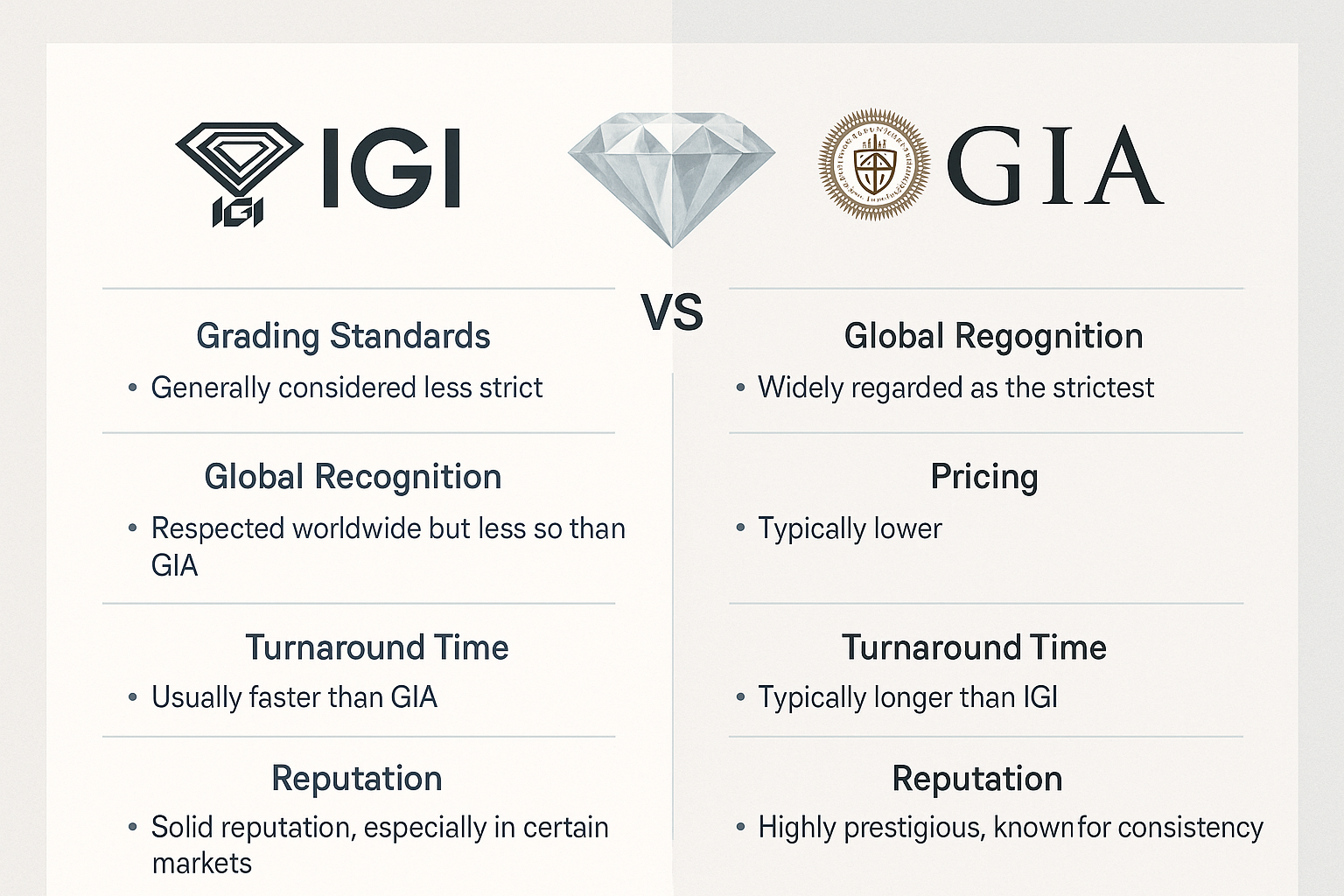
IGI certificates are the de facto standard for lab-grown diamonds and are fully legitimate. Alibaba buyers should verify the certificate number on IGI's official site and understand IGI grades can be slightly more generous than GIA.
Why IGI Certificates Matter for Lab-Grown Diamonds: What Alibaba Buyers Need to Know About Grading Trust
The International Gemological Institute, founded in Antwerp in 1975, issues the single most common grading document you'll encounter when buying a lab-grown diamond. IGI invested heavily in the lab-grown market earlier than any other major lab, making it the dominant certifying body in that space today. If every vendor you've spoken to on Alibaba is showing you IGI papers, that's not a red flag—it's a reflection of how the lab-grown supply chain actually works.
That said, "IGI certified" is not a synonym for "trustworthy seller." The certificate is only as useful as your ability to verify it, and buying through a wholesale marketplace like Alibaba introduces risks that no grading report can fully eliminate. This guide unpacks what an IGI certificate actually tells you, how it compares to GIA and other labs, and what due diligence looks like when sourcing a lab-grown diamond from an overseas vendor.
Quick Comparison: IGI vs GIA vs GCAL for Lab-Grown Diamonds
| Feature | IGI | GIA | GCAL |
|---|---|---|---|
| Founded | 1975, Antwerp | 1931, USA | 1996, USA |
| Lab-grown diamond focus | Primary focus; earliest major entrant | Added lab-grown grading in recent years | Both natural and lab-grown |
| Grading strictness | Reliable; may grade ~0.5–1 grade more generously than GIA on color/clarity | Most conservative; industry gold standard | Detailed; includes light-performance data |
| Certificate cost | Lower | Higher | Moderate |
| Turnaround time | Faster | Slower | Moderate |
| Certificate verification | Online via igi.org | Online via gia.edu | Online via gcalusa.com |
| Best suited for | Lab-grown diamonds, budget-conscious buyers, online/Alibaba purchases | High-value natural diamonds, investment-grade stones | Buyers wanting optical performance data |
| Market trust level | High for lab-grown; slightly below GIA for naturals | Highest globally | Growing, niche |
What is an IGI certificate, exactly?
An IGI certificate is an official grading report issued by the International Gemological Institute after scientific evaluation of a diamond's quality against international standards. The report documents the diamond's 4C parameters—Cut, Color, Clarity, and Carat weight—along with additional data including fluorescence, polish, symmetry, cutting proportions, and the diamond's shape and measurements. For lab-grown stones, IGI reports also state the growth method (CVD or HPHT), which is critical information that natural-diamond certificates don't need to include.
Every IGI-graded diamond receives a unique report number that is laser-inscribed on the stone's girdle—the narrow band around the widest part of the diamond. This inscription allows you to physically match a stone to its paperwork, and it's one of the first things you should check when a stone arrives.
The institute operates laboratories across Antwerp, New York, Mumbai, Hong Kong, Tokyo, Dubai, and several other cities, according to IGI's grading standards, making it one of the most geographically distributed gemological labs in the world. That global footprint is part of why it became the default certifier for the lab-grown supply chain, which is itself globally distributed.
Is IGI actually trustworthy, or is it "looser" than GIA?
IGI is trustworthy as a grading institution, but its grades are statistically more generous than GIA's, particularly on color and clarity. Industry comparisons consistently show that the same diamond submitted to both labs may receive a color or clarity grade that is half a step to a full step higher from IGI than from GIA.
Practically speaking, an IGI-graded stone listed as F/VS1 might grade as G/VS2 at GIA. That difference affects resale value and, to some extent, the price you should be willing to pay. It does not mean the IGI certificate is fraudulent—it means the grading scale is calibrated slightly differently.
GIA is the "leading authority" with "rigorous grading standards," while IGI is "reliable and cost-effective, popular for online diamond purchases and lab-grown diamond reports," according to Elgrissy Diamonds' grading guide. Both descriptions are accurate. GIA is the gold standard; IGI is the practical standard for the lab-grown market.
For a gift purchase—a stone that will be set in jewelry and worn—this distinction matters less than it would for an investment-grade stone. You're buying a beautiful, certified lab-grown diamond for your wife, not a commodity you plan to liquidate. IGI is entirely appropriate for that purpose.
Why does every Alibaba lab-grown vendor use IGI?
IGI got there first. When the lab-grown diamond market began scaling rapidly in the late 2010s, GIA was still primarily focused on natural diamonds and had not yet built out solid lab-grown grading infrastructure. IGI filled that gap aggressively, establishing itself as the default certification body for CVD and HPHT manufacturers—many of whom are based in India and China, the two countries that dominate lab-grown diamond production.
IGI invested heavily in the cultured diamond market earlier and is currently one of the most important grading agencies in this field. Alibaba's vendor base for lab-grown diamonds is concentrated in Surat (India) and Shenzhen (China), both of which have deep relationships with IGI's regional labs. The result is a near-uniform use of IGI certificates across wholesale lab-grown listings.
GIA has since expanded its lab-grown grading services, but its higher cost and slower turnaround make it less attractive for the high-volume, price-competitive wholesale environment that Alibaba represents. GIA-certified lab-grown stones appear on Alibaba occasionally, but they are the exception.
How do you verify an IGI certificate is real?
Certificate verification means cross-referencing a diamond's physical report number against the issuing laboratory's official online database to confirm the document's authenticity. This step is non-negotiable when buying from an unknown vendor on a wholesale marketplace.
Here's the process:
- Ask the vendor for the full IGI report number (a 9- or 12-digit number printed prominently on the certificate).
- Go to igi.org and use the "Verify Your Report" tool.
- Enter the report number. The database should return the exact specifications listed on the certificate—carat weight, color, clarity, cut, shape, and growth method.
- If the number returns no result, or if the returned data doesn't match the certificate the vendor sent you, walk away.
When the stone arrives, use a loupe or ask a local jeweler to confirm the laser inscription on the girdle matches the report number. This physical verification closes the loop between the paper document and the actual stone.
Confirm the certificate lists the stone as "Laboratory Grown" or "Lab-Created." Legitimate IGI reports for lab-grown diamonds explicitly state the growth origin. Ambiguity on this point is a problem.
What are the real risks of buying lab-grown diamonds on Alibaba?
The IGI certificate is not the risk. The risks are specific to the Alibaba buying environment and exist regardless of which lab certified the stone.
Stone substitution is the most commonly cited concern in online diamond communities. A vendor sends you a stone that matches the certificate in every measurable way—except it's not the same stone that was graded. The girdle inscription verification matters so much because without it, you have no way to confirm the stone in your hand is the one on the paper.
Grade misrepresentation is less common with legitimate IGI certificates but can occur with counterfeit documents. Fake certificates are a real phenomenon in the wholesale diamond trade. The online verification step described above is your primary defense.
Quality inconsistency is a structural feature of the Alibaba marketplace. Vendors range from large, reputable manufacturers to small resellers with limited quality control. An IGI certificate tells you the grade of the stone that was submitted for grading—it doesn't tell you whether the stone was handled carefully afterward, whether it has surface damage from poor storage, or whether the vendor's photos accurately represent the stone's appearance.
No consumer protection infrastructure comparable to a domestic retailer. Alibaba's buyer protection policies exist but are harder to enforce for international transactions involving small parcels. If a dispute arises, resolution can be slow and uncertain.
None of these risks make Alibaba an inherently bad place to source a lab-grown diamond. Many buyers do it successfully. But they are risks that a purchase from a reputable domestic retailer largely eliminates—at a higher price.
How does IGI grading work for lab-grown diamonds specifically?
IGI's lab-grown diamond grading process involves systematic evaluation of a CVD- or HPHT-grown diamond against the same 4C criteria applied to natural diamonds, with the addition of origin disclosure and growth-method identification. The physical and optical properties of a lab-grown diamond are identical to a mined diamond of equivalent grade. The certificate reflects real quality measurements, not a different or inferior standard.
The IGI report for a lab-grown stone includes:
- Shape and cutting style (e.g., Round Brilliant, Princess, Oval)
- Measurements in millimeters
- Carat weight to two decimal places
- Color grade on the D-to-Z scale
- Clarity grade (FL through I3)
- Cut grade (Excellent through Poor, for round brilliants)
- Polish and symmetry grades
- Fluorescence (None through Very Strong)
- Growth method (CVD or HPHT)
- Comments on any notable characteristics
The growth method disclosure is particularly useful for buyers who care about the production process. CVD (Chemical Vapor Deposition) and HPHT (High Pressure High Temperature) produce chemically identical diamonds, but some buyers have preferences. The IGI report removes ambiguity on this point.
Should you pay more for a GIA-certified lab-grown diamond from an Alibaba vendor?
Occasionally, Alibaba vendors will list GIA-certified lab-grown stones at a premium. Whether that premium is worth paying depends on your use case.
GIA is the "most conservative" rating agency with "a smaller margin of error" in color and clarity determination. A GIA grade carries more weight in the secondary market and with fine jewelry retailers. If you're buying a stone you might eventually trade in, upgrade, or resell, GIA certification provides better liquidity.
For a gift purchase—a stone that will be set in jewelry and worn—the practical difference between an IGI-graded VS1/F and a GIA-graded VS1/F is essentially invisible to the naked eye and to anyone who isn't a trained gemologist. The stone will look the same. The experience of wearing it will be the same. The sentimental value will be the same.
Where the grade difference becomes material is if you're comparing prices. If a vendor is selling an IGI-graded G/VS2 at the same price as a GIA-graded G/VS2, the IGI stone may actually be closer to H/SI1 on GIA's scale. That's a meaningful quality difference at the same price point. Price IGI stones against IGI comparables, not against GIA comparables.
What questions should you ask an Alibaba vendor before buying?
Beyond requesting the IGI certificate, ask these questions to assess vendor reliability:
About the stone:
- Can you provide the full IGI report number so I can verify it at igi.org before purchase?
- What is the growth method (CVD or HPHT)?
- Can you provide high-resolution photos and a video of the actual stone under natural light?
- Is the girdle laser-inscribed with the IGI report number?
About the transaction:
- What is your return policy if the stone doesn't match the certificate?
- Do you have references from previous international buyers?
- What shipping method do you use, and is the stone insured in transit?
- Can you provide a commercial invoice that accurately describes the stone and its value (for customs purposes)?
About the vendor:
- How long have you been selling on Alibaba, and what is your feedback score?
- Are you a manufacturer, a cutter, or a reseller?
A vendor who hesitates on the certificate verification question or refuses to provide a video of the actual stone is worth avoiding, regardless of how competitive their price is.
How does IGI certification affect the resale or upgrade value of a lab-grown diamond?
Lab-grown diamond resale value deserves honest discussion: lab-grown diamonds have depreciated significantly in price as production costs have fallen, and the secondary market for them is thinner than for natural diamonds. An IGI certificate does not insulate a lab-grown stone from this market dynamic.
What the certificate does do is make the stone tradeable at all. A stone without any certification from a recognized lab is essentially unsellable in the secondary market—no retailer will accept it for trade-in or upgrade without their own appraisal, and private buyers have no basis for trust. An IGI certificate, even with its slightly more generous grading reputation, gives the stone a documented identity that enables transactions.
If resale or upgrade potential is a priority, buying from a domestic retailer with an explicit upgrade policy—rather than from Alibaba—is the more practical path. Many lab-grown diamond retailers in India and elsewhere offer upgrade programs tied to the original purchase price. Alibaba vendors generally do not.
Are there other certifications you might encounter on Alibaba?
Beyond IGI and GIA, a few other certificates appear in the wholesale market:
GCAL (Gem Certification and Assurance Lab) is a US-based gemological laboratory that provides grading reports with the addition of light-performance analysis, including brilliance, fire, and scintillation scores. GCAL is a "detailed, niche" option that is gaining traction for transparency. It's a legitimate certificate but less common on Alibaba.
SGL (Solitaire Gemological Laboratories) is an India-based lab that certifies a large volume of stones in the domestic Indian market. SGL certificates are less recognized internationally and should be treated with more caution in a cross-border transaction.
HRD Antwerp is a Belgian lab with a solid reputation in Europe, roughly comparable to IGI in terms of market standing. It occasionally appears on Alibaba listings from European-adjacent suppliers.
EGL (European Gemological Laboratory) has a problematic reputation for inconsistent grading and is generally not recommended. EGL is described as "less trusted due to less rigorous standards" compared to GIA. If an Alibaba vendor is offering stones with EGL certificates at prices that seem too good to be true, they probably are.
The practical rule: IGI and GIA are the two certificates worth paying for. Everything else requires additional scrutiny.
What's the bottom line for the Alibaba buyer making a gift?
IGI certificates are legitimate, meaningful, and appropriate for lab-grown diamond purchases—including purchases made through Alibaba. The certificate tells you what you're getting in terms of measurable quality. The verification process (report number lookup at igi.org, girdle inscription check on arrival) gives you reasonable assurance that the stone matches the paper.
The risks in an Alibaba purchase are not about IGI's credibility as a lab. They're about the wholesale marketplace environment: vendor reliability, stone substitution, shipping damage, and limited recourse if something goes wrong. Mitigate those risks through careful vendor selection, thorough pre-purchase questions, and physical verification on arrival.
For a gift—a piece of jewelry your wife will wear and value for its meaning rather than its resale potential—an IGI-certified lab-grown diamond sourced carefully from a reputable Alibaba vendor is a perfectly reasonable choice. The certificate is fine. The due diligence is what matters.
If you want to explore finished ring options with IGI-certified lab-grown stones from vetted retailers, the best lab-grown diamond engagement rings in India for 2026 and oval solitaire options in the 1.5–2 carat range are worth reviewing as benchmarks for quality and pricing before you commit to a wholesale purchase.
Sources
- Are IGI certificates ok? (Reddit/LabDiamonds)
- IGI vs GIA: Which Diamond Certification Should You Trust? — Amanda Fine Jewelry
- Your Guide to Diamond Certification and Grading: GIA vs IGI — Elgrissy Diamonds
- International Gemological Institute — Official Site
- Best Lab-Grown Diamond Engagement Rings to Buy in India (2026) — Lab Diamond Insights
- 1.5 to 2 Carat Oval Lab-Grown Diamond Solitaire Rings: What to Know Before Buying in India (2026) — Lab Diamond Insights
- How Lab-Grown Diamonds Hold Up Under Daily Wear: Real User Durability Reports — Lab Diamond Insights
Related
- Why Natural Diamonds' Unique Characteristics Are Winning Against Lab-Grown: What Brands Need to Know
- Why Do Lab-Grown Diamonds Show Different Color Saturation Than Natural Diamonds? A Grading Comparison
- Lab-Grown Diamond Resale Value: What You Actually Get Back, and Why It Rarely Matters for Most Buyers