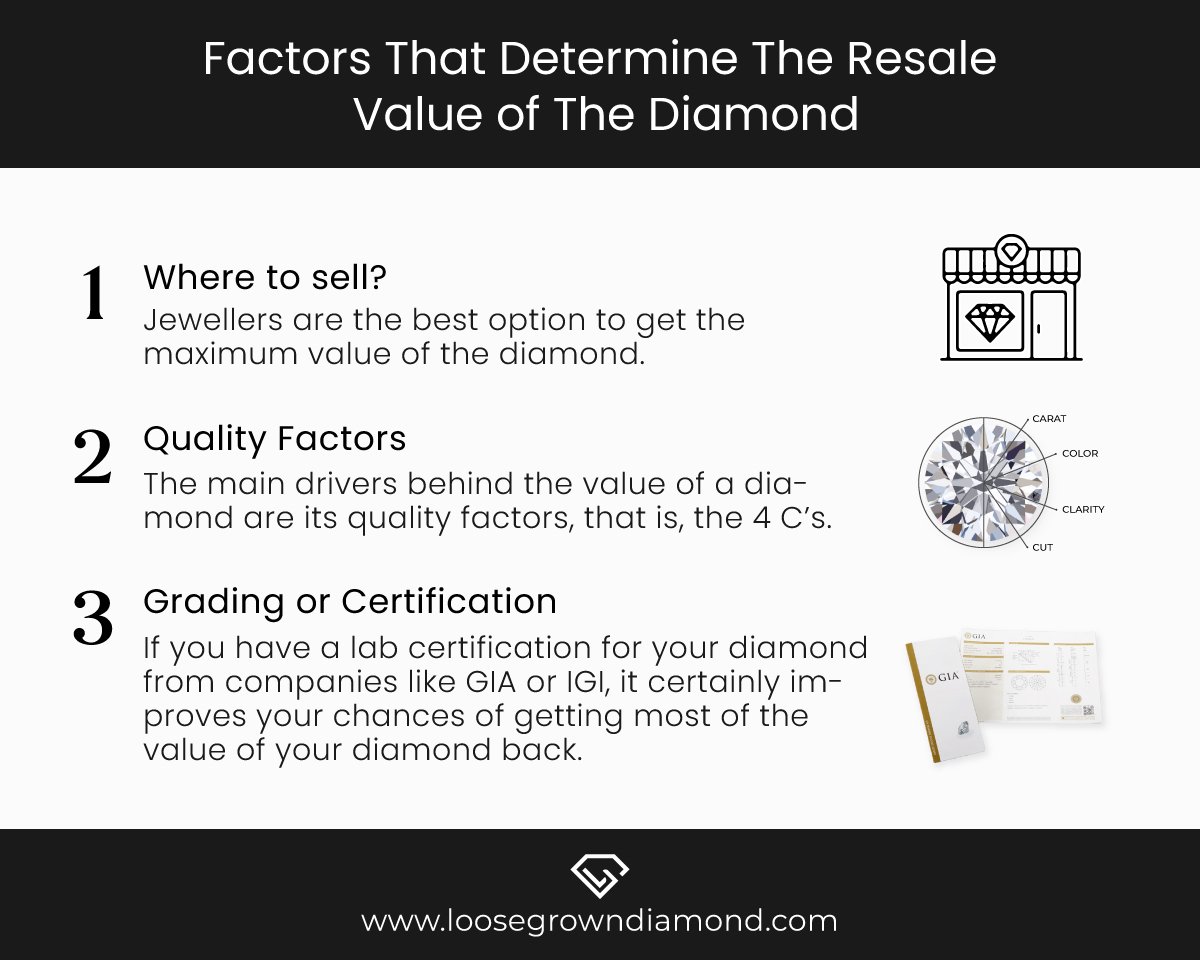
Lab-grown diamonds resell for roughly 10 to 30 percent of purchase price, well below the 25 to 60 percent typical of natural diamonds, because falling production costs and ample supply keep retail prices moving down. For anyone buying to wear rather than to resell, this is a minor factor compared to budget, design, and how the stone looks on the hand.
Lab-Grown Diamond Resale Value: What You Actually Get Back, and Why It Rarely Matters for Most Buyers
A jeweler recently posted on Reddit about a pendant they made with lab-grown diamonds a few years ago: a piece they're proud of, paired with the discovery that the stones are now worth a fraction of what they paid and that the secondary market showed little interest in buying them back. It's a useful anecdote, not because it's alarming, but because it captures something every buyer and retailer should understand clearly before they buy: lab-grown diamonds are not a financial instrument, and treating them as one sets up disappointment that has nothing to do with the stone's quality or the piece's beauty.
This isn't a temporary dip or a market hiccup. It's a direct consequence of how lab-grown diamonds are made and priced, and once you understand the mechanism, the resale numbers stop being surprising.
Here's how lab-grown and natural diamond resale compare across the metrics that matter most to anyone holding inventory or planning a purchase:
| Factor | Lab-Grown Diamond | Natural Diamond |
|---|---|---|
| Typical resale return (% of purchase price) | 10–30% | 25–60% |
| Retail price trend | Declining 15–20% annually | Relatively stable |
| 1ct D-F, VVS-VS1 retail price (2026) | ~$1,000–$1,500 | ~$4,500–$7,000 |
| Price change since 2021 (2ct example) | Roughly 75% lower today | Modest fluctuation |
| Jeweler buyback availability | Limited; many programs exclude lab-grown stones | Established channels exist |
| Secondary market infrastructure | Still developing | Mature (estate dealers, auctions) |
| Considered a financial investment? | No | Debatable |
| Common certifications | IGI, GIA | GIA, AGS, IGI |
This table isn't meant to talk anyone out of a lab-grown diamond. It's here so the resale conversation, if it comes up, is grounded in numbers rather than guesswork.
Why Have Lab-Grown Diamond Prices Fallen So Much?
Since lab-grown diamonds entered the mainstream market, retail prices have dropped 70 to 80 percent in some categories over the past several years. The reason is mechanical, not mysterious: growing a diamond in a lab, whether through High Pressure High Temperature (HPHT) or Chemical Vapor Deposition (CVD), no longer requires the capital-intensive infrastructure it once did. As more growers enter the market and the technology matures, production costs fall, and those savings get passed to buyers as lower retail prices. This is the same pattern that played out with solar panels, flat-screen TVs, and LED lighting: a manufactured product gets cheaper as the manufacturing process improves and scales.
The practical effect for today's buyer is mostly upside. A 2-carat lab-grown diamond that retailed for $6,000 to $8,000 in 2021 can be purchased new for $1,200 to $1,500 today, which means the same budget now buys a noticeably larger or higher-grade stone than it did a few years ago. The flip side is that anyone who bought at 2021 prices and hoped to sell later is comparing their purchase price to a market that has since repriced the underlying commodity. The stone hasn't changed. The price of new stones has simply continued to fall, which is good news if you're buying and a relevant fact to know if you're thinking about reselling.
Why Doesn't Lab-Grown Resale Work Like Natural Diamond Resale?
Natural diamonds hold more resale value, typically 25 to 60 percent of retail, because mining is expensive, geographically constrained, and politically complex, which keeps supply meaningfully limited. That scarcity creates a floor beneath secondary-market prices: a buyer of a used natural diamond knows that new stones cost real money to extract, so the used stone has a built-in price anchor.
Lab-grown diamonds don't have that floor, because supply isn't limited the way mined supply is. A secondary-market buyer can often purchase a brand-new, certified lab-grown stone from a wholesaler for close to what a used one would cost, so there's little reason to pay a premium for a pre-owned stone. This is the same dynamic as buying a used laptop or phone: the hardware works fine, but a newer, cheaper model is usually available, so resale prices reflect that competition rather than the item's condition.
This is exactly what the Reddit jeweler ran into. The pendant's stones aren't worthless in any meaningful sense; they're physically identical to brand-new stones and will look and perform the same for as long as they're worn. What changed is that the secondary market has no incentive to pay extra for a used stone when comparable new ones are cheaper. Wholesale data shows some lab-grown stones have lost a significant share of their value within just a couple of years of purchase, which is a fact about pricing trends, not a verdict on the stone itself.
What Should You Expect If You Try to Sell?
If you do decide to sell a lab-grown diamond, it's worth knowing what a realistic offer looks like so you're not caught off guard. A typical jeweler offer runs 20 to 40 percent of today's retail price, calculated against current prices rather than what you originally paid. Since today's retail prices are often well below historical purchase prices, the dollar amount you receive can feel smaller than the percentage suggests.
A simple example: you pay $2,000 for a certified 1-carat lab-grown diamond. If you sell it later, expect somewhere around $200 to $600. If you bought the same stone in 2020 for $4,000, a dealer will price against today's $1,000 to $1,500 retail value and offer 40 to 50 percent of that, which might land around $400 to $600 on the original $4,000 purchase.
Some jewelers have responded to thin resale demand by not buying lab-grown diamonds back from the public at all, and the resale infrastructure that exists for natural diamonds (estate jewelers, auction houses, certified pre-owned dealers) is still developing for lab-grown stones. One industry estimate puts typical resale at 10 to 30 percent of the retail purchase price, which lines up with what the Reddit jeweler experienced.
None of this means a lab-grown diamond is a bad purchase. It means the purchase makes the most sense when it's evaluated as jewelry you'll enjoy, not as an asset you're holding for a return.
Does Certification Help If You Ever Do Resell?
Certification is an independent grading report from a recognized gemological laboratory, most commonly GIA (Gemological Institute of America) or IGI (International Gemological Institute), documenting a diamond's cut, color, clarity, and carat weight.
A lab-grown diamond with a GIA or IGI grading report is consistently easier to resell than an uncertified stone. Certification gives buyers confidence, documents the 4Cs independently of the seller's word, and is a baseline requirement for most estate dealers and online resale platforms. Whether you're buying for yourself or for inventory, insisting on a grading report is one of the simplest things you can do to keep your options open later. It won't change the underlying price trend, but it removes one real barrier to a future sale.
The Other Side of the Math: Why Lower Resale Percentage Doesn't Mean a Worse Deal
Percentage-based comparisons can be misleading on their own, because lab-grown diamonds cost far less at retail to begin with. A natural diamond purchased for $6,000 that resells at 40 percent returns $2,400. A lab-grown diamond purchased for $1,500 that resells at 20 percent returns $300. The percentage is worse for the lab-grown buyer, but the dollar loss is dramatically smaller: $3,600 lost on the natural diamond versus $1,200 on the lab-grown one.
In some comparisons, the gap in dollars lost between a lab-grown stone and a comparable natural one runs from a few thousand dollars to well over ten thousand, depending on size and quality tier. For the majority of buyers who never plan to resell, the lower entry cost of a lab-grown stone means more stone, a better setting, or simply more budget left over for other priorities. That's the practical upside that gets lost when the conversation focuses only on resale percentages.
This framing matters most for a buyer who's never going to sell the ring, which describes most people who buy one. The Reddit jeweler describes their lab-grown pendant as "a sick pendant" even while noting the financial outcome. That's the right way to hold both facts at once: the regret is about a financial assumption, not about the craftsmanship or the experience of wearing the piece.
Where resale value matters more is for buyers who are explicit about wanting an investment, or who are buying in a context where the stone might need to be sold later (an estate situation, a major life change). For those buyers, the honest framing is that lab-grown diamonds aren't designed to function as a financial investment, and neither, frankly, are most natural diamonds once you factor in markup and resale friction. Both are jewelry first.
Will Prices Eventually Stabilize?
Some industry analysts expect price declines to slow as the lab-grown market matures and consolidates around fewer, larger producers. The reasoning: as production becomes dominated by efficient large-scale operations, the rate of cost decline should ease, eventually finding a floor.
As of 2026, that stabilization hasn't clearly arrived yet, and production costs continue to fall as new growers enter regions with lower energy costs. Whether prices settle in two years or ten is hard to say with confidence. The practical takeaway for buyers is simple: don't assume today's price is the floor, and don't buy more stone than you need on the assumption that it will hold value over time. Buy what you love, at a price that feels comfortable today, and let the rest take care of itself.
For jewelers and retailers, this points toward buying inventory closer to actual need rather than stockpiling, and being upfront with customers about how the market works. Clear expectations set at the point of sale are far better for long-term customer relationships than a surprised customer discovering the resale reality on their own later.
Where Can You Sell a Lab-Grown Diamond If You Need To?
If circumstances mean you do need to sell, a few channels tend to perform better than others. Selling directly to another individual, through marketplaces or specialized jewelry resale sites, typically yields more than selling to a dealer, since you're not paying a middleman's margin. Selling peer-to-peer can get you closer to 75 percent of today's retail price, though remember that retail price itself may already be well below what you originally paid.
Pawn shops and general jewelers tend to offer wholesale or below, and some won't take lab-grown stones at all. Estate dealers and auction houses, the traditional channels for natural diamond resale, are largely absent from the lab-grown secondary market simply because that buyer demand and pricing infrastructure haven't built up yet.
Some retailers run upgrade or trade-in programs with better terms than the open market, including full purchase-price credit toward a larger stone or partial buyback credit. Many major retailers exclude lab-grown stones from these programs entirely, so it's worth checking a retailer's specific policy before you buy if trade-in flexibility matters to you.
So Should You Buy a Lab-Grown Diamond?
If the question is whether lab-grown diamonds make sense to wear and enjoy, the answer is a clear yes for most buyers. They're chemically, physically, and optically identical to mined diamonds, with the same hardness, brilliance, and daily durability. If you want a larger stone, a more elaborate setting, or simply prefer to spend less on the stone itself, lab-grown diamonds deliver real value the moment you put the ring on. The durability and daily wear performance of lab-grown diamonds holds up well, full stop.
What's worth being clear-eyed about is the resale question specifically, because that's a different story than the wearing experience. If you're buying primarily as jewelry, the resale numbers in this guide are background information, not a reason to reconsider. If you're buying with resale or appreciation specifically in mind, this is the one area where lab-grown and natural diamonds diverge meaningfully, and it's worth factoring into the decision honestly.
For jewelers, the lesson from the Reddit anecdote isn't to avoid lab-grown inventory. It's to price and manage it as a consumable input into finished jewelry rather than a store of value, and to be transparent with customers about that distinction upfront. Customers who understand the resale picture before they buy are far less likely to feel let down later, and they're the ones who tend to come back and refer others.
If you're choosing between lab-grown and natural diamonds for an engagement ring, the honest answer on resale is that lab-grown stones will likely keep relatively little of their value, and natural diamonds, while better on this metric, aren't a reliable investment either once markup and resale friction are accounted for. Neither stone should be the centerpiece of a financial plan. The decision is best made on what you actually value: size, budget, ethics, design, and how the ring looks on the hand, with clear eyes about what the secondary market will and won't offer if that ever becomes relevant.
The Reddit jeweler's pendant is beautiful: real diamonds, physically indistinguishable from mined stones, set in 18k yellow gold with black glass enamel accents. The lesson worth keeping is narrow and specific: the stones are real, the craftsmanship is real, and the resale economics are also real, but none of those three facts contradicts the others. A ring can be a wonderful, lasting piece of jewelry and also not function as an investment. Most jewelry, lab-grown or natural, fits that description.
Sources
- This is my favorite pendant I've ever made, and I regret making it with lab diamonds (Reddit)
- Lab-Grown Diamond Resale Value: What to Expect — BR Diamonds
- Lab Grown Diamond Value: The Honest Truth About Resale Worth in 2026 — Liori Diamonds
- How Lab-Grown Diamonds Hold Up Under Daily Wear: Real User Durability Reports — Lab Diamond Insights
- Best Lab-Grown Diamond Engagement Rings to Buy in India (2026) — Lab Diamond Insights