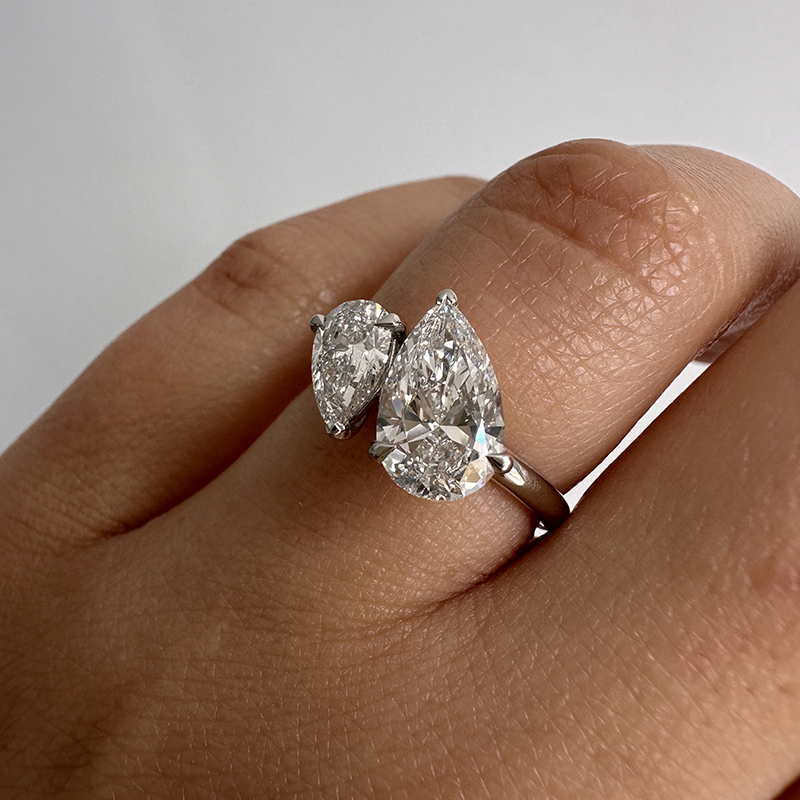
Toi et Moi Pear Diamond Rings: How to Choose the Right Two-Stone Style for You
Toi et moi pear rings pair two pear diamonds on one band; Indian options range from ₹83,000 (Ashth) to ₹1.25 lakh+ (True Diamond), with Graff at the luxury end.
A toi et moi ring is a two-stone design in which each stone represents one partner, set side by side on a shared band. The pear cut, with its elongated teardrop silhouette, is among the most expressive shapes for this format. Pear diamonds face outward from the centre, their pointed tips creating a natural visual tension that pulls the eye across the ring rather than anchoring it in a single solitaire. When two pear stones are paired—especially in contrasting colours such as fancy yellow and white—the effect is both graphic and deeply personal.
In the Indian market, toi et moi pear rings now span a wide range: from accessible lab-grown designs priced around ₹83,000 to personalised dual-colour pairings near ₹1.25 lakh, with international luxury houses like Graff sitting at the top of the market with natural fancy yellow diamonds and bespoke pricing. The five rings compared below cover that full spectrum, each occupying a distinct niche.
At-a-Glance Comparison
| Feature | Harsh & Rushali Toi-et-Moi (True Diamond) | Gold Two Stone Pear (Pure Jewels) | Two Pear Diamond Ring (House of Quadri) | Dazzling Two Stone (Ashth) | Icon Pear Yellow & White (Graff) |
|---|---|---|---|---|---|
| Stone type | 1 ct yellow pear + 1 ct white pear lab diamond | Two pear-shaped diamonds | Two pear-shaped diamonds | Two pear-cut lab-grown diamonds | Natural fancy yellow pear + white diamond |
| Total carat weight | 2 ct (1+1) | Not disclosed | Not disclosed | Not disclosed | Not disclosed |
| Metal options | 14 KT or 18 KT; Yellow, Rose, or White Gold | Gold | Not disclosed | Not disclosed | Platinum and gold |
| Colour combination | Yellow + white | White + white | Not disclosed | Not disclosed | Fancy yellow + white |
| Personalisation | Named ring (Harsh & Rushali); personalised | Standard ready-made | Standard ready-made | Standard ready-made | Bespoke luxury |
| Approx. price (INR) | From ₹1,25,000 (14 KT) | ₹1,06,000 | ₹1,15,000 | ₹83,000 | Not disclosed (luxury tier) |
| Best for | Personalised dual-colour pear toi et moi | Classic yellow-gold two-stone pear | Minimalist refined two-pear look | Budget-friendly lab-grown pear toi et moi | Luxury natural fancy yellow + white pairing |
What exactly is a toi et moi ring, and why does the pear shape work so well?
Toi et moi—French for "you and me"—describes a ring style rooted in romantic tradition, where two gemstones of equal or complementary presence share a single band. The format gained renewed cultural momentum after high-profile proposals in the early 2020s brought it back into mainstream bridal conversation.
The pear cut earns its place in this format for several structural reasons. Its asymmetry means the two stones can be oriented to mirror each other—points facing inward toward the centre of the ring—creating a heart-like negative space between them. Alternatively, an east-west orientation (both stones lying horizontally across the finger) produces a more contemporary, architectural look that reads as bold from across a room. Linara Custom Jewellery in Toronto notes that the east-west placement "creates a balanced, contemporary look that emphasizes the paired design and elongates the finger differently than the traditional vertical orientation."
The pear's brilliant-cut faceting maximises light return from a relatively shallow stone, which matters when two stones must share visual real estate without one overpowering the other. A well-matched pair of pear diamonds—whether identical in colour or deliberately contrasted—will each hold their own brilliance while reading as a unified composition.
For buyers considering a yellow-and-white pairing, the colour contrast does additional symbolic work: the warm yellow stone and the cool white stone can represent two distinct personalities, two birthstones, or simply a design preference for chromatic tension. This logic underpins both True Diamond's Harsh and Rushali ring at the accessible end and Graff's Icon ring at the luxury end—the same fundamental idea executed at very different price points and with different stone origins.
How do the five main options compare in detail?
Harsh and Rushali's 1 ct Yellow Pear Diamond & 1 ct White Pear Diamond Toi-et-Moi Ring — True Diamond
True Diamond's Harsh and Rushali ring pairs exactly 1 ct of yellow pear lab diamond with 1 ct of white pear lab diamond—a total of 2 ct across both stones. The naming convention stands out: unlike most jewellers who sell anonymous ring styles, True Diamond assigns couple names to specific designs, making the ring feel personalised from the moment of purchase rather than requiring a custom order.
The ring is available in 14 KT or 18 KT gold, with setting colour options across yellow gold, rose gold, and white gold—six configuration combinations before factoring in stone grading choices. The 14 KT starting price of approximately ₹1.25 lakh positions it in the mid-range of the Indian lab-grown engagement market, above the entry-level Ashth option but below the House of Quadri and Pure Jewels alternatives when adjusted for the explicit 2 ct total weight.
For buyers who want a dual-colour pear toi et moi without the lead time and uncertainty of a fully custom order, this ring addresses a niche that none of the other four products directly fill. The yellow-and-white combination is available off the shelf, the carat weights are specified, and the personalised naming adds an emotional layer that resonates particularly well in the Indian gifting context where provenance and story matter.
Gold Two Stone Pear Engagement Ring — Pure Jewels
Pure Jewels' Gold Two Stone Pear Engagement Ring executes the format classically: two pear-shaped diamonds in a gold setting with a contemporary east-west orientation. Priced at approximately ₹1.06 lakh, it sits at the lower end of the mid-range tier and is the most accessible of the three rings in the ₹1–1.25 lakh band.
The east-west pear orientation gives the ring a horizontal, modern silhouette—both stones lie across the finger rather than pointing toward the knuckle. This suits buyers who find the traditional vertical pear orientation too conventional and want the toi et moi format to read as clearly contemporary. Stone colour combination and total carat weight are not disclosed in the product listing, which matters for buyers comparing specifications directly.
The Pure Jewels brand operates within the Indian fine jewellery market and focuses on accessible gold diamond jewellery, making this ring a practical choice for buyers prioritising a clean, recognisable two-stone design without the premium of personalisation or colour contrast.
House of Quadri Two Pear Diamond Ring
House of Quadri's two-pear ring takes a minimalist, refined approach to the toi et moi format, priced at approximately ₹1.15 lakh. The design philosophy leans toward restraint—a setting that lets the pear diamonds carry the visual weight without ornamental distraction from the band or prong work.
Specific details including total carat weight, metal options, and stone colour combination are not disclosed in available product information, making direct specification comparisons difficult. What the ring offers is a distinct aesthetic niche: buyers who find the Pure Jewels option too straightforward and the True Diamond ring too colour-forward may find this approach—pared-back, jeweller-focused, quietly confident—more aligned with their taste.
At ₹1.15 lakh, it sits between the Pure Jewels and True Diamond options in price, and its minimalist positioning suggests it targets buyers for whom the design language of the setting matters as much as the stone specifications.
Toi et Moi Dazzling Two Stone Lab Grown Diamond Pear Cut Ring — Ashth
Ashth's Dazzling Two Stone ring is the most budget-accessible option in this comparison, priced at approximately ₹83,000. It uses two pear-cut lab-grown diamonds in a toi et moi silhouette, making it the entry point for buyers who want the format and the lab-grown stone category without stretching to the mid-range price band.
Lab-grown diamonds are chemically, physically, and optically identical to mined diamonds—a fact now well-established across gemological bodies—and the Ashth ring benefits from the significant cost advantage that lab-grown production offers. For buyers whose priority is maximising visible stone size and the symbolic two-stone format within a constrained budget, this ring delivers the core proposition at a price point roughly 30–35% below the True Diamond option.
Stone colour combination, carat weight, and metal options are not disclosed in available product information. The Etsy platform listing suggests a smaller-scale or independent jewellery operation, which may appeal to buyers who prefer supporting independent makers but may also mean less standardised after-sales service than a dedicated jewellery brand.
Icon Pear Shape Yellow Diamond and White Diamond Engagement Ring — Graff
Graff's Icon ring is the only option in this comparison using natural fancy yellow diamonds, representing the luxury tier of the yellow-and-white pear toi et moi category. Graff is one of the world's foremost high jewellery houses, with a particular reputation for sourcing and cutting exceptional fancy coloured diamonds—the fancy yellow category being among its signature specialisations.
The Icon ring pairs a natural fancy yellow pear diamond with a white diamond in a setting available in both platinum and gold. Price is not publicly disclosed, which is standard for Graff's product range; buyers should expect to engage directly with a Graff boutique for pricing, which will reflect the rarity premium of natural fancy yellow diamonds alongside the house's craftsmanship and brand positioning.
For buyers for whom natural stone provenance is non-negotiable and budget is not a primary constraint, the Graff Icon ring is the reference-point luxury option in the yellow-and-white pear toi et moi format. It shares the fundamental design concept with True Diamond's Harsh and Rushali ring but operates in an entirely different market segment—natural versus lab-grown, bespoke luxury versus accessible personalisation.
What should I know about yellow pear diamonds specifically?
Fancy Yellow is a colour grade assigned by gemological laboratories—including the GIA—to diamonds that display a vivid, saturated yellow hue visible to the naked eye. This differs from the faint or very light yellow that appears in the lower end of the D-to-Z colour scale; Fancy Yellow stones have crossed a threshold of saturation that earns them a separate, positive colour designation rather than a deduction from the colourless ideal.
In natural diamonds, Fancy Yellow colour results from nitrogen atoms within the crystal lattice during formation. In lab-grown diamonds, the same colour can be produced through controlled nitrogen introduction during the CVD or HPHT growth process, or through post-growth irradiation and annealing. The visual result—a warm, golden yellow—is identical regardless of origin, and the colour grade assigned by a gemological certificate uses identical terminology.
The pear shape interacts with yellow colour in a specific way worth understanding before purchase. Because the pear cut concentrates colour at the pointed tip (the culet end), a yellow pear diamond can appear more intensely coloured at its point than at its rounded shoulder. This is generally considered desirable in fancy coloured stones, where colour saturation is the goal, but buyers should view stones in person or request video under multiple lighting conditions to understand how the colour distributes across the specific stone they are considering.
For the yellow-and-white pairing format, the contrast between a warm yellow pear and a cool white pear is most visually striking when the yellow stone is at least Fancy grade. Fancy Light yellow will read as a subtle accent next to a white diamond, while Fancy Intense or Fancy Vivid will hold its own as a true co-equal stone. The Linara Custom Jewellery team notes that "Fancy Yellow indicates a highly saturated, vivid yellow colour that is rare and prized for its lively intensity," and recommends this grade specifically for buyers who want the yellow stone to read as genuinely coloured rather than merely warm.
How does the toi et moi format translate into the Indian engagement ring market?
The Indian engagement ring market has historically been dominated by solitaire designs—a single stone, often round brilliant, in a prong or bezel setting. The toi et moi format represents a meaningful departure from this convention, and its adoption in India has accelerated alongside broader shifts in how younger buyers approach engagement jewellery: more personal, more design-led, more willing to depart from inherited conventions.
Several factors make the toi et moi pear format particularly well-suited to the Indian market right now. The two-stone symbolism—two people, one ring—translates directly across cultural contexts and requires no explanation. The pear shape's elongating effect on the finger is widely appreciated. Lab-grown diamonds have made the format accessible at price points that would have been impossible with natural stones even five years ago.
The ₹83,000–₹1.25 lakh price band covered by Ashth, Pure Jewels, House of Quadri, and True Diamond represents a sweet spot for urban Indian buyers in their late twenties and thirties who are purchasing engagement rings independently rather than through family jewellers. These buyers typically research online, compare specifications, and make considered purchases—which is why transparent pricing and disclosed specifications matter so much in this segment.
For buyers considering the True Diamond Harsh and Rushali ring specifically, the named design format addresses a real gap in this market. Most Indian online jewellers offer customisation as a separate, longer-lead process; a ready-made ring that already carries a couple's names—or names that resonate personally—offers the emotional payoff of personalisation without the wait. This format is more common in Western bridal markets and relatively novel in the Indian lab-grown space.
If you are exploring broader options in the Indian lab-grown engagement ring market, the best lab-grown diamond engagement rings guide for India (2026) covers a wider range of styles and price points, while the best two-stone yellow and white pear diamond engagement rings for 2026 goes deeper on this specific colour pairing.
What are the key decisions when choosing a toi et moi pear ring?
Stone orientation: mirrored points inward vs. east-west
The two dominant orientations for pear toi et moi rings are mirrored (points facing inward, creating a heart-shaped negative space between the stones) and east-west (both stones lying horizontally across the finger). Mirrored orientation is more traditional and romantic in its visual reference; east-west is more architectural and contemporary. Neither is objectively superior—the choice depends on the wearer's aesthetic preference and how the ring sits against their hand shape.
Colour combination: matched vs. contrasted
Matched white-and-white pear toi et moi rings (as in the Pure Jewels and House of Quadri options) offer a clean, unified look where the design interest comes from the two-stone format itself rather than colour contrast. Contrasted yellow-and-white pairings (True Diamond, Graff) add a chromatic dimension that makes the two stones read as genuinely distinct—more explicitly symbolic of two different people. The contrasted format requires more careful stone selection to ensure the yellow and white stones are balanced in size and visual weight.
Carat weight: per stone vs. total
When comparing toi et moi rings, distinguish between per-stone carat weight and total carat weight. A ring described as "2 ct" could mean two 1 ct stones (as in the True Diamond Harsh and Rushali ring) or one 1.5 ct and one 0.5 ct stone. For visual balance in a toi et moi design, matched or near-matched stone sizes are generally preferable—a significant size disparity between the two stones can undermine the equality that the format is meant to symbolise.
Metal: 14 KT vs. 18 KT, and colour
For yellow-and-white pear pairings, yellow gold settings tend to complement the warm yellow stone while creating a slight contrast with the white diamond. White gold or platinum settings make the white diamond appear brighter but may slightly mute the yellow stone's warmth. Rose gold offers a middle path—warm enough to complement the yellow stone, neutral enough not to compete with it. The True Diamond ring's three setting colour options across two karat weights give buyers meaningful flexibility here.
For buyers who want to understand how different settings perform under daily wear conditions, the lab-grown diamond durability guide covers real-world performance data across setting types.
Natural vs. lab-grown
Natural fancy yellow diamonds carry a rarity premium that reflects their geological origin—the Graff Icon ring is the only option in this comparison using natural stones. Lab-grown yellow diamonds, as used in the True Diamond Harsh and Rushali ring and the Ashth option, offer the same visual and physical properties at a significantly lower price point. For buyers for whom stone origin is a meaningful factor—whether for ethical, environmental, or investment reasons—this distinction warrants careful consideration.
Lab-grown diamonds are not a compromise on quality; they are a different origin story. The decision between natural and lab-grown is ultimately a values question as much as a budget question, and both positions are defensible depending on what the buyer prioritises.
What does the pear cut's shape mean for setting and durability?
The pear diamond's pointed tip is its most distinctive feature and also its most vulnerable point. The tip concentrates stress and is susceptible to chipping if struck against a hard surface—a risk that is higher for pear cuts than for round brilliants or cushion cuts, which have no sharp termination points.
For toi et moi settings where the pear tips face inward toward each other, the tips are partially protected by their proximity to the centre of the ring and to each other. For east-west orientations, both tips are exposed at the sides of the ring and more vulnerable to lateral impacts. A well-made setting will use a V-prong or bezel at the tip specifically to protect this point—buyers should confirm this detail with any jeweller before purchase.
The pear shape also requires careful attention to the bow-tie effect: a dark, bow-tie-shaped shadow that appears across the centre of poorly proportioned pear diamonds when viewed face-up. This results from light leaking through the pavilion rather than reflecting back to the viewer. A well-cut pear diamond will have a minimal bow-tie; a poorly cut one will have a prominent dark zone that reduces apparent brilliance. Since bow-tie severity is not captured in standard grading reports, buyers should view pear diamonds in person or via video before purchasing—particularly for stones above 0.5 ct where the effect becomes more visible.
For buyers considering how different ring styles hold up over time, the curved solitaire engagement rings guide covers related setting durability considerations that apply across fancy-shaped diamond rings.
How should I think about pricing across these five options?
The price range across these five rings—from ₹83,000 (Ashth) to undisclosed luxury pricing (Graff)—reflects several distinct variables operating simultaneously: stone origin (lab-grown vs. natural), disclosed carat weight, metal karat, brand positioning, and personalisation premium.
Within the lab-grown segment, the Ashth ring at ₹83,000 represents the entry point. The Pure Jewels ring at ₹1.06 lakh, the House of Quadri ring at ₹1.15 lakh, and the True Diamond Harsh and Rushali ring at ₹1.25 lakh (14 KT) form a mid-range cluster where the price differences reflect design complexity, brand positioning, and—in True Diamond's case—the explicit specification of 2 ct total weight across two named stones.
The Graff Icon ring operates outside this pricing framework entirely. Natural fancy yellow diamonds of the quality Graff sources are priced by the carat at multiples of what lab-grown yellow diamonds cost, and Graff's craftsmanship and brand premium add further to the total. This ring is not a direct competitor to the Indian lab-grown options in budget terms; it is the reference point for buyers who want to understand what the format looks like at the apex of the market.
For buyers working within the ₹1–1.25 lakh band, the meaningful decision is between the Pure Jewels classic approach, the House of Quadri minimalist approach, and the True Diamond personalised dual-colour approach. Each has a coherent rationale; the right choice depends on whether the buyer prioritises design simplicity, aesthetic restraint, or the emotional specificity of a named yellow-and-white pairing.
Are there other pear toi et moi styles worth knowing about?
Beyond the five rings in this comparison, the broader market for pear toi et moi designs includes options with halo settings around each stone—a format that Linara Custom Jewellery uses to intensify the colour saturation of fancy yellow pear diamonds by surrounding each centre stone with a pavé ring of matching yellow accent diamonds. This approach maximises the visual impact of the colour but adds complexity and cost to the setting.
Spiral wrap bands—where the metal band appears to twist around the stones—are another design variant that adds movement and modernity to the toi et moi format. These work particularly well with pear diamonds because the asymmetry of the pear shape gives the band a natural direction to follow.
For buyers interested in exploring the full range of two-stone yellow and white pear diamond options beyond this comparison, the best two-stone yellow and white pear diamond engagement rings guide covers additional styles and considerations in depth.
The toi et moi pear format is genuinely versatile: it accommodates minimalist restraint (House of Quadri), classic gold jewellery tradition (Pure Jewels), personalised storytelling (True Diamond), budget-conscious lab-grown purchasing (Ashth), and high jewellery luxury (Graff) without any of these interpretations feeling like a compromise of the format's core idea. Two stones, one ring, one story—the execution is where individual taste enters.
Last verified: 2026-06-27
Sources
- Harsh and Rushali's 1 Ct Yellow Pear Diamond & 1 Ct White Pear Diamond Toi-et-Moi Ring
- Two Stone Pear Shape Diamond Gold Engagement Ring — Pure Jewels
- 2 Carat Pear Shape Diamond Toi et Moi Engagement Ring — Pure Jewels (House of Quadri)
- Two Stone Pear Cut Diamond Engagement Ring — Ashth (Etsy)
- Icon Pear Shape Yellow Diamond and White Diamond Engagement Ring — Graff
- Two-Stone Pear Yellow Diamond Engagement Ring — Linara Custom Jewellery
- Best Two-Stone Yellow and White Pear Diamond Engagement Rings to Buy in 2026 — Lab Diamond Insights
- Best Lab-Grown Diamond Engagement Rings to Buy in India (2026) — Lab Diamond Insights
- How Lab-Grown Diamonds Hold Up Under Daily Wear: Real User Durability Reports — Lab Diamond Insights
- Best Curved Solitaire Engagement Rings to Buy in India (2026) — Lab Diamond Insights
Related Articles
- Best Two-Stone Yellow and White Pear Diamond Engagement Rings to Buy in 2026
- Curved Solitaire Engagement Rings: How to Choose the Right Band Style, Metal, and Fit
- Lily Cut Diamond Rings: What to Know Before You Buy
- Women's Diamond Solitaire Ring Buying Guide: How to Choose the Right Stone, Setting & Certification