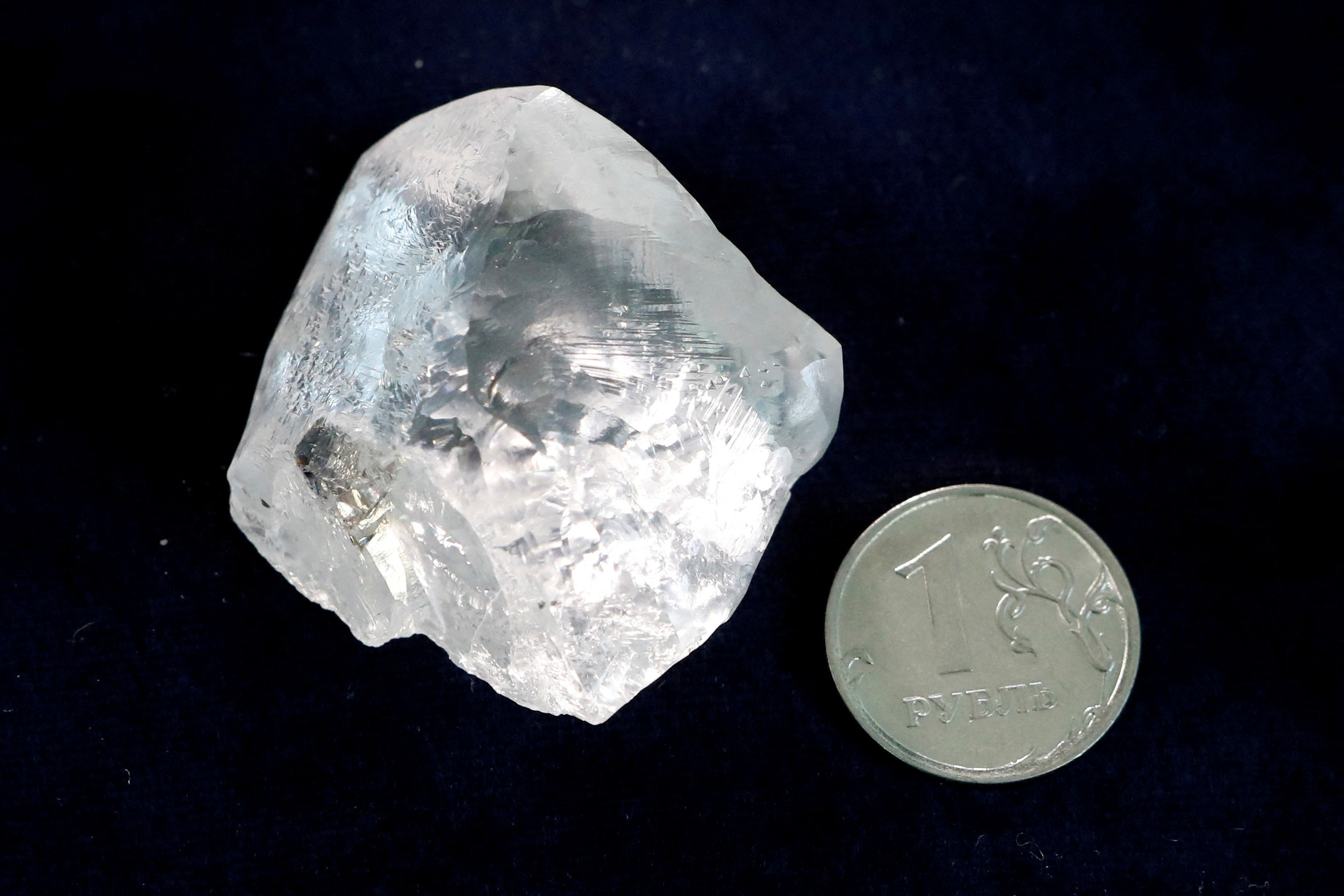
OFAC's General License 104B extends the US import deadline for pre-ban Russian diamonds to September 1, 2027, keeping origin-traceability questions alive for Indian natural diamond buyers.
US Postpones Russian Diamond Import Deadline to 2027: What It Means for Natural Diamond Buyers in India Checking Origin and Pricing
The US Treasury's Office of Foreign Assets Control (OFAC) extended its deadline for importing certain "grandfathered" Russian-origin loose diamonds by one full year — to September 1, 2027 — through the issuance of General License No. 104B on August 27, 2026. For natural diamond buyers in India, this is more than a Washington policy footnote: India cuts and polishes roughly 90% of the world's diamonds, and a significant share of the rough that entered Indian factories before 2024 originated from Russia's Alrosa mines. Understanding what this extension does — and does not — permit is essential for anyone buying a natural diamond solitaire, checking a stone's origin certificate, or comparing natural versus lab-grown options.
The table below summarises the three active OFAC authorisations governing Russian-origin diamond trade as of September 2026.
| OFAC Instrument | What It Covers | Key Cutoff Date | US Import Deadline |
|---|---|---|---|
| General License 104B | Non-industrial loose Russian diamonds ≥ 1 ct, substantially transformed outside Russia | Must have left Russia before March 1, 2024 | September 1, 2027 |
| General License 104B | Non-industrial loose Russian diamonds 0.5–0.99 ct, substantially transformed outside Russia | Must have left Russia before September 1, 2024 | September 1, 2027 |
| General License 103 | Diamond jewelry (set stones) physically outside Russia before March 2024 sanctions | Must have left Russia before March 1, 2024 | No change — original terms still apply |
| No license available | Any Russian-origin diamond mined, extracted, or produced after the applicable cutoff dates | N/A — fully banned | Prohibited indefinitely |
The distinction between these categories separates legacy inventory — stones already in global supply chains before the G7 ban — from newly sourced Russian diamonds that entered trade after the ban's effective dates. Only the former qualifies for the exemption.
What exactly is General License 104B and why does it matter?
General License 104B is an OFAC authorisation permitting US persons and businesses to import specific categories of Russian-origin non-industrial diamonds that were physically located outside Russia before the applicable sanctions deadlines, provided those stones were not subsequently re-exported back to Russian territory. OFAC released the updated license on August 27, 2026, superseding General License 104A, which was set to expire on September 1, 2026.
The original General License 104 was issued in March 2024 alongside the sanctions themselves, recognising that a large volume of Russian rough had already been shipped to cutting centres — primarily in India — before the ban took effect. Without a grandfathering provision, polished diamonds sitting in Surat factories or Mumbai trading houses would have been stranded: legally cut and polished, but unsellable in the US market. The industry lobbied successfully to have these goods exempted, and the Jewelers Vigilance Committee, Jewelers of America, the American Gem Society, the Diamond Manufacturers and Importers Association of America, the Diamond Dealers Club, the Indian Diamond & Colorstone Association, and the Diamond Club West Coast co-signed a formal letter requesting the most recent renewal.
The extension to 2027 does not open any new door for Russian diamonds. It gives traders additional time to clear pre-ban inventory through the US market under strict documentation conditions.
Which diamonds are actually covered — and which are not?
The eligibility criteria under General License 104B are precise. A diamond qualifies only if it meets all of the following conditions simultaneously:
- It is a non-industrial diamond (gem-quality, not industrial-grade abrasive).
- It was mined or produced in Russia (or is of unknown origin that could be Russian).
- It was physically located outside the Russian Federation before the relevant cutoff date — March 1, 2024 for stones ≥ 1 carat, and September 1, 2024 for stones of 0.5–0.99 carats.
- It has not been exported or re-exported back to Russian territory since those dates.
- It has been substantially transformed outside Russia — meaning cut, polished, or otherwise processed in a third country such as India, Belgium, or the UAE.
The phrase "substantially transformed" is critical. OFAC's FAQ 1165 explicitly states that a diamond mined in Russia but cut and faceted in India is still considered of Russian origin for sanctions purposes. This was a deliberate policy choice to prevent Russian rough from being laundered through Indian cutting centres. The grandfathering exemption exists precisely because this transformation was already happening on a massive scale before the ban, and abruptly cutting off that pipeline would have caused severe disruption in Surat and Mumbai.
Diamonds that do not qualify include:
- Any Russian rough purchased after the applicable cutoff dates, even if cut in India.
- Diamonds that re-entered Russia after the cutoff dates.
- Industrial-grade diamonds of Russian origin (these fall under separate restrictions).
- Diamonds covered by other sanctions programs (e.g., stones linked to specifically designated nationals beyond the Alrosa listing).
Why does India sit at the centre of this story?
India is the world's largest diamond cutting and polishing hub, processing an estimated 90% of global rough diamond production by volume. Surat in Gujarat accounts for the vast majority of this activity, with Mumbai serving as the primary trading and export centre through the Bharat Diamond Bourse.
Before the G7 sanctions, Alrosa — Russia's state-controlled diamond miner and the world's largest rough diamond producer by volume — was a major supplier to Indian factories. When Alrosa was placed on the US Specially Designated Nationals (SDN) list in April 2022 following Russia's invasion of Ukraine, direct US-Alrosa transactions became prohibited. Rough diamonds could still flow from Alrosa to third-country intermediaries and then to Indian cutters, however, making the original source difficult to trace in finished polished goods.
The G7's phased ban, which took effect from March 2024, was specifically designed to close this loophole by banning Russian-origin diamonds "even if such diamonds have been substantially transformed into other products outside of the Russian Federation," as OFAC's FAQ 1165 states. Indian polished diamond exporters now face US buyers demanding clear documentation that their goods are not of Russian origin — or, if they are, that they fall within the grandfathered window.
The 2027 extension gives Indian traders additional runway to move pre-ban Russian-origin polished inventory into the US market. It also prolongs the period during which Indian exporters must maintain meticulous chain-of-custody records to prove eligibility.
What documentation do Indian diamond traders and buyers need?
Per OFAC compliance guidance and Eurasia Business News reporting on the extension, businesses importing under General License 104B must be able to demonstrate:
- The diamond's country of origin (Russia or unknown).
- Its weight (to confirm it falls within the ≥ 0.5 carat threshold).
- Its physical location before the applicable cutoff date (outside Russia before March 1, 2024 or September 1, 2024).
- That it was not re-exported to Russian territory after the cutoff.
- That no blocked individuals or entities are involved in the transaction.
Acceptable documentation includes customs declarations, shipping records, invoices, inventory logs, certificates of origin, and chain-of-custody information. The Jewelers Vigilance Committee's Sara Yood specifically advised companies to keep source documentation on all goods, noting that "the industry did not place as much emphasis on origin prior to the implementation of sanctions in 2022."
For Indian retail buyers purchasing natural diamonds domestically, this documentation chain rarely surfaces at the point of sale. A consumer buying a solitaire ring in a Mumbai or Delhi jewellery store is unlikely to receive a Russian-origin disclosure. The sanctions framework is, however, pushing the entire supply chain — from rough to retail — toward greater traceability, and that shift will eventually reach Indian consumers.
How does this affect natural diamond pricing in India?
The pricing impact is indirect but real. Several forces are at work simultaneously.
Russian rough accounted for a substantial share of global supply in the 1-carat-and-above category — precisely the size range most popular for engagement rings. With newly sourced Russian diamonds banned from the US market (the world's largest diamond consumer), and with the grandfathered window now extended rather than closed, there is no sudden supply shock. The long-term trajectory, though, is toward tighter supply of large natural diamonds from non-Russian sources, which supports prices over time.
The extension to 2027 also means pre-ban Russian-origin polished stones in the 0.5–1 carat range can continue flowing into the US market for another year. This prevents a price spike that might have occurred if that inventory had been frozen out. For Indian buyers, the mid-tier natural diamond market — the 0.5–0.75 carat range common in Indian bridal jewellery — is unlikely to see sanctions-driven price pressure in the near term.
The sanctions saga has also accelerated a broader conversation about diamond origin and traceability, and lab-grown diamonds sidestep the origin question entirely. They carry no mining provenance, no geopolitical supply risk, and are now available in India at a fraction of the price of comparable natural stones. The JVC's Yood acknowledged that origin "is going to remain a factor for traceability and in conversations the industry is having going forward," including as a marketing tool for natural diamonds competing against lab-grown alternatives.
On the domestic cost side, Indian consumers pay a 7.5% basic customs duty on polished diamonds imported into India, plus GST at 3% on jewellery purchases. These factors dwarf any marginal pricing effect from the US sanctions extension. If the grandfathering window is not renewed after 2027, Indian exporters could face reduced US demand for certain goods, redirecting some supply toward the domestic Indian market and exerting modest downward price pressure.
What happens after September 1, 2027?
Nobody knows for certain. Each renewal of the grandfathering license has been presented as a temporary measure to allow orderly market adjustment, not as a permanent accommodation. The original deadline was September 1, 2025; it was extended to September 1, 2026; it has now been pushed to September 1, 2027.
National Jeweler's reporting notes that the latest renewal is the result of "ongoing industry advocacy work in Washington, D.C." — meaning the extension is not automatic and requires active lobbying each cycle. Whether a fourth extension will be granted depends on the geopolitical situation with Russia, the state of US-Russia relations, and the volume of pre-ban inventory still in circulation.
If the license is not renewed after 2027, any remaining Russian-origin diamonds that had not yet entered the US market would be effectively stranded. For Indian exporters holding such inventory, that represents a significant compliance and commercial risk. Industry bodies are already recommending that traders use the 2027 window to clear eligible inventory while simultaneously building solid origin-documentation systems for all new purchases.
What should Indian natural diamond buyers check when purchasing?
For consumers in India buying natural diamonds — whether for engagement rings, solitaire pendants, or investment purposes — the sanctions framework raises practical questions about what to ask a jeweller.
Ask for a grading certificate from a recognised laboratory. Certificates from the Gemological Institute of America (GIA), International Gemological Institute (IGI), or HRD Antwerp document the 4Cs (cut, colour, clarity, carat weight) but do not typically state country of origin for polished diamonds. Origin certification is a separate and still-evolving field.
Understand that "made in India" does not mean "mined in India." India has no significant diamond mining industry. A polished diamond cut in Surat could have originated from mines in Russia, Botswana, Canada, Australia, or elsewhere. The cutting location and the mining origin are different data points.
Ask about provenance documentation if origin matters to you. Some jewellers — particularly those selling to export markets or operating in the premium segment — now maintain chain-of-custody records. If you are buying a stone above 0.5 carats and origin is important to you, ask whether the retailer can provide documentation showing the rough's source.
Consider lab-grown diamonds if origin traceability is a priority. Lab-grown diamond solitaire rings and engagement rings are produced in controlled environments — typically using Chemical Vapour Deposition (CVD) or High Pressure High Temperature (HPHT) processes — and carry no geopolitical supply-chain risk. Their origin is definitionally traceable to a specific production facility. If you are buying at a lab-grown diamond store in Delhi or elsewhere in India, the origin question is straightforward.
Do not assume price reflects origin. A natural diamond priced at a premium does not necessarily come from a non-Russian source. Pricing in the Indian retail market is driven primarily by the 4Cs, the brand, and the metal setting — not by the mine of origin.
How does this fit into the broader G7 diamond sanctions picture?
The G7 diamond sanctions framework is a coordinated set of import restrictions adopted by the United States, European Union, United Kingdom, Canada, Japan, and other G7 partners beginning in December 2023, targeting Russian-origin diamonds to reduce revenue flowing to Russia's economy and specifically to Alrosa.
The approach has been phased and imperfect. The EU has separately struggled with traceability implementation, pushing back its own diamond traceability deadline multiple times. The G7 announced Botswana as a second verification "node" for rough diamonds in November 2024, part of a longer-term plan to build a global rough diamond tracking system. US Customs separately indefinitely postponed a requirement to disclose country of mining in March 2025, reflecting the practical difficulty of implementing origin verification at scale.
The result is a sanctions regime that is directionally clear — Russian diamonds should not reach Western markets — but operationally messy, with multiple extensions, postponements, and carve-outs reflecting the supply chain's deep historical entanglement with Russian rough.
For Indian buyers, the practical takeaway is that the diamond you purchase today in India may well have been cut from Russian rough, and that is not illegal under Indian law. India has not adopted the G7 diamond sanctions. The sanctions apply to US-market transactions. The global push toward traceability does mean, however, that over the next five to ten years, origin documentation will become a standard part of the diamond retail experience — much as it already is for certain luxury goods.
Does this affect the Maruti Suzuki e Vitara or other EV purchases?
Not directly. The broader consumer mindset around ethical sourcing and supply-chain transparency driving the diamond sanctions debate is the same mindset increasingly shaping EV purchasing decisions. Buyers who ask where a diamond was mined are often the same buyers who ask where an EV's battery minerals were sourced. The Maruti Suzuki e Vitara sources its battery technology through a Suzuki-Toyota partnership, and as India's EV market matures, battery mineral provenance is likely to face similar scrutiny to what the diamond industry is navigating today. Regulatory and consumer pressure toward supply-chain transparency is a cross-sector trend, not a diamond-specific phenomenon.
What is the bottom line for Indian natural diamond buyers right now?
The OFAC General License 104B extension to September 1, 2027 does three things relevant to Indian consumers.
First, it confirms that pre-ban Russian-origin polished diamonds — including those cut and polished in India — can continue to enter the US market for another year under strict documentation conditions, preventing a sudden supply disruption that could have pushed up prices.
Second, it extends the period of origin-documentation uncertainty for Indian exporters, who must maintain records proving their goods qualify under the grandfathering criteria. This compliance burden is real and ongoing.
Third, it signals that the G7 sanctions on Russian diamonds are a long-term structural shift, not a temporary measure. Each renewal of the grandfathering window is a managed wind-down, not a reversal of policy. Indian buyers who care about origin should start asking questions now, because the industry's documentation infrastructure is being built in real time.
If you are buying a natural diamond above 0.5 carats in India today and origin matters to you, ask your jeweller for whatever provenance documentation they have. If they cannot provide any, that is not necessarily a red flag — the industry's record-keeping before 2022 was genuinely poor — but it is useful information. And if you want complete origin certainty, lab-grown diamonds remain the only category where the question has a definitive answer.
Sources
- US Postpones Deadline for 'Grandfathered' Russian Diamond Imports - Rapaport
- OFAC General License No. 104B - US Treasury
- OFAC Frequently Asked Questions - Russian Diamond Prohibitions
- OFAC General License No. 103 - US Treasury
- US Extends Import Exemptions for Certain Russian Diamonds Until September 2027 - Eurasia Business News
- OFAC Renews License Allowing Import of 'Grandfathered' Russian Diamonds - National Jeweler
- EU Once Again Pushes Back Deadline on Diamond Traceability - National Jeweler
- Customs Indefinitely Postpones Requirement to Disclose Country of Mining - National Jeweler
- G7 Announces Botswana as Second Verification Node for Rough Diamonds - National Jeweler
- Best Lab-Grown Diamond Engagement Rings to Buy in India (2026) - EV Index India
- Best Lab-Grown Diamond Stores in Delhi - EV Index India
- 1.5 to 2 Carat Oval Lab-Grown Diamond Solitaire Rings: What to Know Before Buying in India - EV Index India