GSI now issues "Pigeon Blood," "Royal Blue," and "Padparadscha" color trade-name reports from Jaipur and Mumbai — India's first — but only for fully untreated rubies and sapphires.
GSI's New Gemstone Color Classification Reports in India 2026: What 'Pigeon Blood' and 'Royal Blue' Labels Mean for Buyers
On August 19, 2026, Gemological Science International (GSI) began issuing gemstone color classification reports from its Jaipur and Mumbai laboratories — the first time internationally recognized color trade names such as "Pigeon Blood," "Royal Blue," and "Padparadscha" have been formally assigned to gemstones inside India, as Rapaport News reported.
For Indian gem buyers, jewellers, and traders, this is a structural shift. A fine ruby or sapphire finished in Jaipur no longer needs to travel to Bangkok, New York, or Zurich to carry one of these high-value designations. The cost savings, reduced transit risk, and faster turnaround are immediate practical benefits — but the deeper significance lies in what these labels actually mean, and whether a stone in your hands genuinely qualifies for one.
Below is a quick-reference comparison of the three color trade names now available through GSI India, followed by a detailed breakdown of how the system works and what buyers need to verify.
| Color Trade Name | Gemstone | Treatment Eligibility | Scientific Basis | Labs Issuing in India |
|---|---|---|---|---|
| Pigeon Blood | Ruby | Untreated only | Hue, tone, saturation + spectroscopy | Jaipur, Mumbai |
| Royal Blue | Sapphire | Untreated only | Hue, tone, saturation + spectroscopy | Jaipur, Mumbai |
| Padparadscha | Sapphire | Untreated only | Hue, tone, saturation + spectroscopy | Jaipur, Mumbai |
All three designations are consistent across GSI's global network — Jaipur, Mumbai, New York, and Bangkok — through shared master reference sets, calibrated instrumentation, and proficiency testing of qualified gemologists, as GSI confirmed via its official news channel.
What exactly are "Pigeon Blood," "Royal Blue," and "Padparadscha" — and why do they matter?
These three terms are recognized color trade names within the gemological industry — shorthand descriptors that evolved from centuries of gem trading into formally codified, scientifically measurable standards.
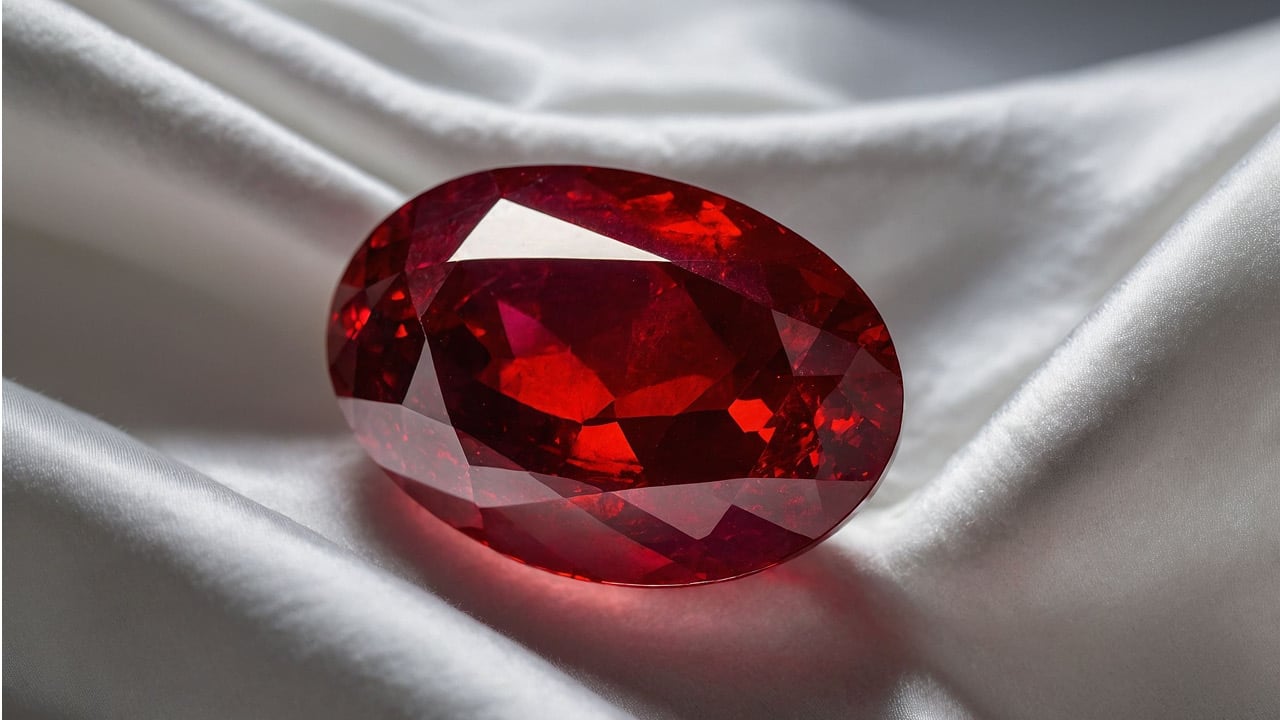
Pigeon Blood describes a specific quality of red in rubies: a pure, vivid hue with a slightly bluish overtone, high saturation, and a medium-dark tone. The name originates from Burmese gem trading traditions, where the finest Mogok rubies were compared to the color of the first two drops of blood from a freshly killed pigeon's eye. Today the term has been stripped of its poetic ambiguity and anchored to measurable colorimetric coordinates. A ruby carrying this designation commands a significant premium over stones of similar carat weight that fall just outside the qualifying range.
Royal Blue describes a saturated, velvety blue in sapphires — typically a medium to medium-dark tone with strong saturation and minimal gray or green secondary hues. The finest examples historically come from Kashmir, Burma (Mogok), and Sri Lanka, though origin alone does not guarantee the designation. What matters is whether the stone's measured color falls within the accepted hue, tone, and saturation range under standardized lighting.
Padparadscha is the most contested of the three. It describes a rare variety of sapphire displaying a delicate blend of pink and orange — named after the Sinhalese word for the lotus blossom. The qualifying color range is narrow: too orange and it becomes a standard orange sapphire; too pink and it loses the designation. Padparadscha sapphires are among the rarest and most valuable colored gemstones in the world, and the label has historically been applied inconsistently across laboratories, making GSI's standardized criteria particularly relevant here.
The practical implication for buyers is straightforward: a GSI color trade-name report is a documented, laboratory-backed assertion that a specific stone meets the measurable criteria for one of these designations — not a subjective opinion from a seller.
How does GSI scientifically determine whether a stone qualifies?
GSI's color classification process rests on three interlocking layers of analysis, as described across its official communications and industry coverage.
Colorimetric analysis measures the stone's color objectively using calibrated instruments that quantify hue (the dominant wavelength of color), tone (the lightness or darkness of the color), and saturation (the intensity or vividness of the color). These three dimensions together define where a stone sits in color space. Each trade name corresponds to a specific, documented range within that space — a stone either falls within the range or it does not.
Spectroscopic analysis goes deeper, examining how the stone interacts with light across different wavelengths. For rubies, this can reveal the characteristic chromium fluorescence that contributes to the "glow" associated with the finest Pigeon Blood stones. For sapphires, spectroscopy helps confirm the presence of iron and titanium absorption patterns consistent with natural, untreated color. This layer of analysis also helps verify treatment status — a critical gating factor for all three designations.
Standardized lighting is the third pillar. Color perception changes dramatically under different light sources, and assessing all stones under standardized conditions eliminates the variability that has historically made color trade-name designations unreliable when applied by eye alone.
The system is maintained through shared master reference sets across all GSI laboratories — physical or digital reference standards against which every assessed stone is compared. Combined with regular proficiency testing of the gemologists conducting assessments, this means a stone assessed in Jaipur should receive the same determination as one assessed in New York or Bangkok. That claim is verifiable in principle, since the same stone could theoretically be submitted to multiple labs.
Why does the "untreated only" rule matter so much?
The single most important eligibility criterion for all three color trade names is treatment status: only fully untreated stones qualify, as GSI's announcement covered by Indian Jeweller makes clear. Heated, diffused, or otherwise enhanced material is ineligible regardless of how closely its color matches the qualifying range.
This rule exists because heat treatment is the most common enhancement applied to rubies and sapphires — and it is specifically designed to improve color. A heated ruby that displays Pigeon Blood color after treatment is not the same as a natural ruby that formed with that color in the ground. The market prices these two categories very differently, and the color trade-name designation exists precisely to identify the latter.
The scale of this distinction is worth appreciating. The vast majority of commercial rubies and sapphires on the market have been heat treated. Industry estimates vary, but some gemologists suggest that over 90% of rubies sold commercially have undergone some form of heat treatment. The pool of stones that can qualify for a Pigeon Blood, Royal Blue, or Padparadscha designation is therefore genuinely small — which is part of what makes the designation valuable.
For buyers, a GSI color trade-name report implicitly contains two separate pieces of information: the stone's color meets the qualifying standard, and the stone is untreated. Both must be true simultaneously. A report that confirms treatment status separately but does not carry the color trade name should be read accordingly.
GSI's reports also document other gemological characteristics alongside the color designation — treatment status, species and variety identification, and other relevant data — so the color trade-name designation sits within a broader certification context rather than standing alone.
What does this mean for Jaipur's gem trade specifically?
Jaipur is India's primary colored gemstone trading and cutting hub — a city that has shaped the global supply of rubies, sapphires, emeralds, and other precious stones for centuries. Its gem cutters and traders have long possessed the expertise to evaluate and finish the world's finest material. What they lacked, until now, was the domestic laboratory infrastructure to assign internationally recognized color trade names to that material.
The practical consequence of this gap was significant. A ruby cut and finished in Jaipur to the highest standards would need to be sent to a laboratory in Bangkok, New York, or Zurich to receive a Pigeon Blood designation. That process adds cost (shipping, insurance, laboratory fees), time (weeks of turnaround), and risk (transit damage or loss). For high-value stones, these are manageable but real friction points.
GSI's global head gemologist Meenu Brijesh Vyas framed the significance directly: "Jaipur has cut and traded the world's finest rubies and sapphires for generations, yet a stone finished here has always had to travel abroad to carry a name like Pigeon Blood. That ends today," she said at the launch. "It is a matter of real pride that the first laboratory in India to define these names is doing so from the city that has shaped these stones for centuries — the expertise was always here, and now the authority is too."
For the Indian gem trade, this is not merely a logistical convenience. It is a credentialing shift that positions Jaipur and Mumbai as full participants in the global fine gemstone certification space, rather than production centers that must defer to overseas labs for the final stamp of quality. Manufacturers and dealers can now use these reports directly in domestic and export sales without the additional step of overseas certification. Retailers gain the ability to source certified fine material without the delays that previously made domestic certification impractical for time-sensitive transactions.
How does GSI's color classification compare to other major gemological laboratories?
GSI is not the first laboratory to issue color trade-name reports. The Gübelin Gem Lab, GRS (Gem Research Swisslab), and the American Gemological Laboratories (AGL) have offered similar designations for years, and the Gemological Institute of America (GIA) has its own color grading methodology for colored stones. What GSI's India launch changes is the geography of access.
It is worth understanding where GSI sits in the broader laboratory space. GSI is one of the world's largest gemological organizations, operating 13 laboratories across major global hubs including the United States, India, Hong Kong, Dubai, and Thailand, per GSI's own FAQ documentation. The organization is known primarily for diamond grading reports, which are widely accepted by major retail chains globally. Its colored stone capabilities have historically been less prominent than those of specialist labs like Gübelin or GRS, which have built decades of reputation specifically around colored gemstone origin and color trade-name reports.
This context matters for buyers. A Pigeon Blood designation from Gübelin or GRS carries a specific market reputation built over many years. GSI's entry into this space in India is significant and the methodology described is scientifically sound, but the market's acceptance of GSI color trade-name reports at equivalent price premiums to those issued by established specialist labs will develop over time. Buyers purchasing stones with GSI color trade-name reports should understand that they are working with a credible but relatively new entrant in this specific certification category.
That said, the standardization argument GSI makes is compelling. Shared master reference sets, calibrated instrumentation, and proficiency testing across all issuing labs (Jaipur, Mumbai, New York, Bangkok) provide a structural basis for consistency that is verifiable and auditable. The claim that a stone assessed in Jaipur receives the same determination as one assessed in New York is a testable proposition, and the methodology described supports it in principle.
What should a buyer actually check when presented with a GSI color trade-name report?
When a seller presents a ruby or sapphire with a GSI color trade-name report, several specific things are worth verifying before making a purchase decision.
First, confirm that the report explicitly states the color trade name — "Pigeon Blood," "Royal Blue," or "Padparadscha" — rather than simply describing the color in general terms. A report that describes a ruby as "red" or "vivid red" without the specific trade-name designation is a different document with different market implications.
Second, verify the treatment status section of the report. It should explicitly state that the stone is untreated — "no indications of heating" for rubies and sapphires, or equivalent language. Given that the color trade-name designations are only available for untreated stones, any report carrying the designation should by definition confirm untreated status, but it is worth reading this section directly.
Third, check the issuing laboratory and date. The color trade-name service is currently available at GSI laboratories in Jaipur, Mumbai, New York, and Bangkok. Reports from other labs or predating August 2026 would not be part of this specific program.
Fourth, consider whether the price being asked reflects the designation appropriately. A Pigeon Blood ruby commands a substantial premium over a comparable ruby without the designation — in international markets, this premium can be significant, sometimes doubling or tripling the per-carat price for otherwise similar stones. If a stone is being sold at a price that seems inconsistent with the designation, that warrants scrutiny in both directions: either the price is too low (raising questions about the report's validity) or the designation is being used to justify an inflated price for a stone that might not command that premium in a competitive market.
Fifth, for very high-value purchases, consider obtaining a second opinion from another major laboratory. This is standard practice in the fine gemstone trade for stones above certain value thresholds, and it remains advisable regardless of which laboratory issued the primary report.
Does this affect buyers of lab-grown or synthetic gemstones?
The color trade-name reports issued by GSI under this program apply exclusively to natural, untreated gemstones. Lab-grown rubies and sapphires — which can display colors that visually match or exceed the Pigeon Blood or Royal Blue standards — are not eligible for these designations under GSI's current framework.
This distinction matters for buyers navigating the Indian market, where both natural and lab-grown colored gemstones are sold. A lab-grown ruby with vivid red color may be a beautiful and valuable stone in its own right, but it cannot carry a Pigeon Blood designation under this or any other major laboratory's framework. The designation is specifically tied to natural origin and untreated status.
For buyers primarily interested in color and aesthetics rather than natural origin, this distinction may matter less. For buyers purchasing as an investment or as a store of value — where natural, untreated fine rubies and sapphires have historically commanded strong premiums — the certification is directly relevant to the stone's long-term value.
If you are exploring the broader world of certified gemstones and fine jewelry in India, our guides on lab-grown diamond engagement rings and lab-grown diamond stores in Delhi cover the parallel certification space for diamonds, where similar questions of grading consistency and report credibility apply.
What are the broader implications for India's gemstone export trade?
India is one of the world's largest processors and exporters of colored gemstones, with Jaipur at the center of that supply chain. The ability to certify fine material domestically — with internationally recognized color trade-name designations — has potential implications well beyond the domestic retail market.
For export transactions, a GSI color trade-name report issued in Jaipur carries the same institutional backing as one issued in New York or Bangkok, given the standardization framework GSI has described. This could reduce the need for re-certification at the destination market, simplifying export logistics for high-value material. For the domestic fine jewelry market, the reports provide a new layer of consumer protection and price transparency. Color trade names have historically been applied informally in Indian retail — a seller might describe a ruby as "Pigeon Blood quality" without any laboratory backing, relying on the buyer's inability to verify the claim. A formal GSI report changes that dynamic by providing a documented, scientifically grounded basis for the designation.
The timing of this launch also reflects broader trends in India's gemstone industry. As consumer awareness of gemstone quality and certification has grown — driven partly by the expansion of online jewelry retail and partly by increasing exposure to international certification standards — demand for credible, accessible laboratory services has increased. GSI's decision to launch this service from Jaipur and Mumbai, rather than requiring Indian traders to access it only through overseas labs, responds directly to that demand.
Whether other major laboratories will follow with similar domestic offerings remains to be seen. There has been no public announcement from GIA, Gübelin, or GRS about establishing comparable color trade-name certification services in India as of August 2026. GSI's move may prompt competitive responses, which would further expand the certification options available to Indian buyers and traders.
The bottom line for buyers
GSI's color trade-name reports represent a meaningful addition to India's gemstone certification space. For buyers of fine rubies and sapphires, several things are worth keeping in mind.
The designations — Pigeon Blood, Royal Blue, Padparadscha — are scientifically defined, not marketing language. Each corresponds to a documented, measurable range of hue, tone, and saturation, assessed under standardized conditions and supported by spectroscopic analysis.
Only untreated stones qualify. This is a hard eligibility criterion, not a preference. A heated stone with identical color cannot carry the designation.
The service is now available domestically in Jaipur and Mumbai, eliminating the need to send fine material overseas for certification. This reduces cost, risk, and turnaround time for the Indian trade.
GSI is a credible laboratory with a global standardization framework, but its color trade-name reports are relatively new in the Indian market. Buyers making significant purchases should understand the laboratory landscape and, for very high-value stones, consider corroborating reports from specialist colored stone laboratories.
The reports document more than just color — they also confirm treatment status and other gemological characteristics, providing a full certification document rather than a single-attribute label.
For anyone purchasing colored gemstones in India in 2026, understanding what these labels mean — and what they require to earn — is now a practical necessity rather than specialist knowledge.
Sources
- GSI Releases Gemstone Reports with Color Classification in India - Rapaport
- GSI issues India's first 'Pigeon Blood' reports - JewelleryNet
- GSI begins issuing Pigeon Blood ruby reports in India - Indian Jeweller
- GSI News - Gemological Science International Official Trends
- GSI Issues India's First Pigeon Blood Reports - GSI Official