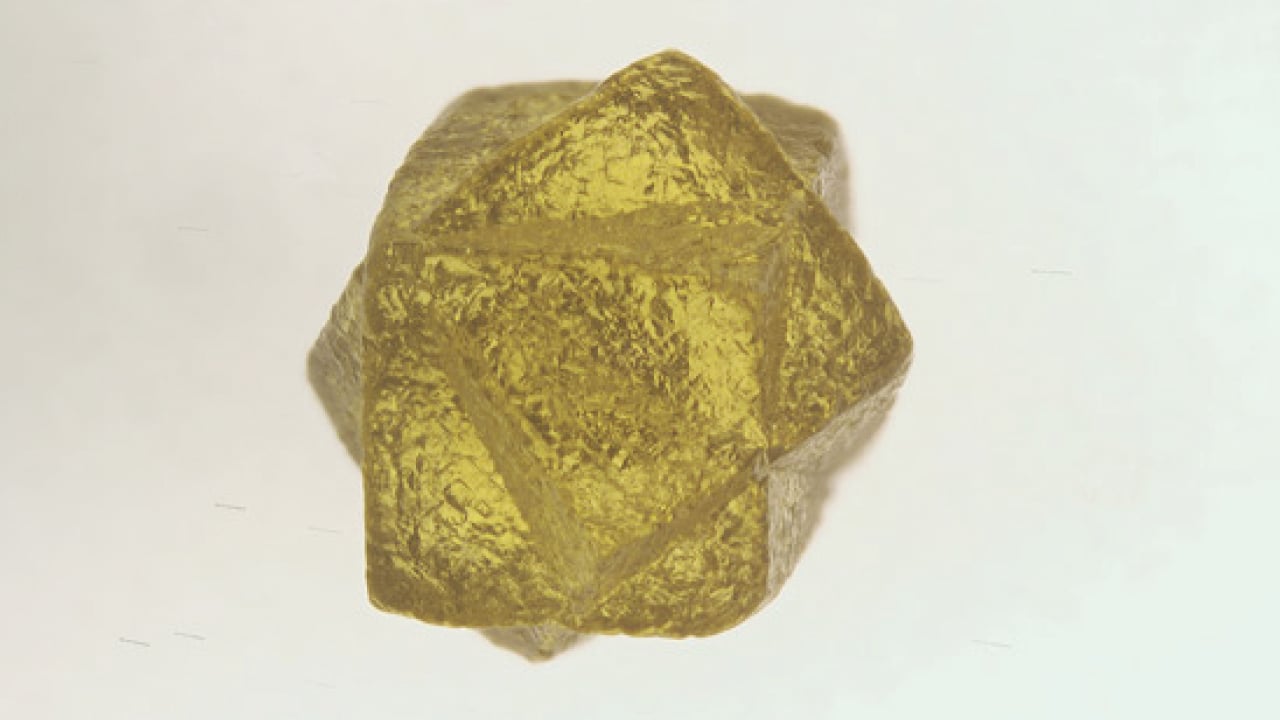
GIA documented penetration twinning in a 0.37-carat natural diamond, a rare crystal growth anomaly impossible to replicate in lab-grown stones, reinforcing the geological uniqueness argument for natural diamonds in 2026.
GIA Detects Penetration Twinning in a Natural Diamond: What Rare Crystal Anomalies Mean for Buyers Choosing Between Natural and Lab-Grown in 2026
In August 2026, the Gemological Institute of America confirmed penetration growth twinning in a 0.37-carat vivid-orangey-yellow natural diamond — one of the rarest crystal formation anomalies documented in gem-quality stones — published in the spring issue of Gems & Gemology and reported by Rapaport News. The finding is more than a gemological curiosity. It crystallises (literally) the core argument that separates natural diamonds from their lab-grown counterparts in 2026: billions of years of geological process produce phenomena that a controlled laboratory environment, by design, eliminates.
For Indian buyers navigating the natural-versus-lab-grown decision — whether for an engagement ring, a heirloom piece, or a considered luxury purchase — understanding what these anomalies mean, how they are detected, and why they matter to value and authenticity is now more relevant than ever.
Natural vs. Lab-Grown Diamonds at a Glance: Key Differences for 2026 Buyers
Before diving into the science of twinning, here is a structured comparison of the factors that matter most at the decision stage:
| Factor | Natural Diamond | Lab-Grown Diamond (HPHT/CVD) |
|---|---|---|
| Origin | Formed 1–3 billion years ago, 150+ km below Earth's surface | Grown in a laboratory in days to weeks |
| Chemical composition | Pure carbon (cubic isometric), often with trace nitrogen or boron | Identical carbon crystal structure; same chemical formula |
| Crystal anomalies | Penetration twinning, contact twinning, inclusions from geological events | Controlled growth; anomalies rare and typically uniform |
| Nitrogen type (spectroscopy) | Can be IaA, IaB, Ib, IIa, IIb — varies by geological history | Usually Type IIa (CVD) or Type Ib (HPHT); more uniform |
| Price (per carat, 2026 approx.) | Higher; finite supply supports price floor | Significantly lower; prices have fallen sharply as production scales |
| Resale / long-term value | Generally stronger; finite supply, established market | Declining resale value as supply expands |
| Certifiability | GIA, IGI, HRD grading widely accepted | GIA and IGI both grade LGDs, but reports are differentiated |
| Detectability | Requires advanced spectroscopy to distinguish from LGD | Identifiable via UV fluorescence, spectroscopy, growth patterns |
| Rarity of specific specimen | Each stone is geologically unique; anomalies like twinning add rarity | Reproducible; no individual geological identity |
| Ethical/environmental profile | Mining impact; traceability improving with Kimberley Process | Lower mining impact; energy-intensive production |
What exactly is penetration twinning, and why is it so rare?
Penetration twinning — also called interpenetrant twinning — is a crystal growth phenomenon in which two crystals of the same mineral grow through each other in a symmetrical, interlocked formation, rather than simply sharing a flat contact surface. GIA's Gems & Gemology documentation of the 0.37-carat vivid-orangey-yellow diamond describes exactly this: two diamond crystals that interpenetrated during growth, creating a single specimen with a symmetrical but internally complex structure.
This is distinct from contact twinning, the more common form. Contact twinning is a growth configuration where two crystals share a single, flat twin plane — like two mirror-image halves joined at a boundary. Contact twins are routinely found in octahedral diamonds, the classic eight-sided crystal habit most people associate with rough diamond. Penetration twins, by contrast, are found specifically in cuboid diamonds — those with a more blocky, cube-like rough form that grew via a fibrous growth mechanism rather than the layer-by-layer growth of octahedral crystals.
The rarity of penetration twinning comes down to the specific conditions required. Fibrous cuboid growth itself is less common than octahedral growth, and for two crystals to interpenetrate symmetrically rather than simply growing side by side requires a very particular set of pressure, temperature, and chemical environment conditions sustained over geological timescales. The GIA stone on loan from the GIA Museum is a textbook example of how unexpected events during crystal growth can produce specimens that are, in the truest sense, one of a kind.
For a buyer, the practical implication is straightforward: no lab-grown diamond will ever exhibit penetration twinning of geological origin. Laboratory growth processes — whether HPHT or CVD — are engineered to be controlled and reproducible. The "unexpected events" that produce twinning anomalies in nature are precisely what manufacturers work to eliminate.
How did GIA confirm the twinning and what did spectroscopy reveal?
The GIA investigation used two primary spectroscopic techniques, both standard in advanced gemological analysis and increasingly relevant to the natural-versus-lab-grown authentication question.
Ultraviolet/visible (UV-Vis) spectroscopy showed broad absorption across the violet-to-blue region of the visible spectrum. This absorption pattern is a characteristic signature of isolated substitutional nitrogen atoms, technically called C-centers — individual nitrogen atoms sitting in place of carbon atoms within the crystal lattice, absorbing certain wavelengths of light and contributing to the stone's vivid-orangey-yellow colour.
Fourier-transform infrared (FTIR) spectroscopy confirmed the presence of both C-centers and A-centers. A-centers are pairs of adjacent nitrogen atoms within the diamond lattice — a configuration that forms over geological time as isolated nitrogen atoms migrate and pair up under sustained high temperature. The combination of both types classifies this diamond as Type IaA+Ib, a mixed nitrogen configuration that is itself a marker of complex geological history.
This nitrogen typing matters enormously for authentication. GIA notes that laboratory-grown diamonds produced by the HPHT method typically contain nitrogen in the Ib (isolated) configuration because they haven't undergone the billions of years of thermal annealing needed to convert isolated nitrogen into paired A-centers. CVD-grown diamonds are usually Type IIa — essentially nitrogen-free — because the CVD process doesn't introduce nitrogen the same way. A natural diamond showing a mixed IaA+Ib signature is displaying a geological fingerprint that a lab simply cannot fake without extraordinary post-growth treatment.
For Indian buyers considering certification, this is why a GIA or IGI grading report that includes spectroscopic data is worth the premium. The report doesn't just tell you the 4Cs — it encodes the stone's geological identity.
Does a rare anomaly like twinning affect a diamond's grade or value?
This is a practical question that deserves a direct answer: it depends on how the anomaly manifests in the finished stone.
The GIA Museum specimen is a 0.37-carat rough — it hasn't been faceted into a gem. In rough form, penetration twinning is a structural feature that a cutter must account for. Twinned diamonds can be harder to cleave or saw along predictable planes because the twin boundary disrupts the crystal's directional cleavage. Some twinned rough diamonds are therefore cut into shapes that work around the twin plane, sometimes resulting in unusual proportions or lower yield from the rough.
In a faceted stone, the twin boundary might appear as an internal graining line — a subtle feature that a gemologist would note but that most buyers would never see. Depending on its position and visibility, it could affect a clarity grade or be entirely invisible in the face-up position. It would not, in itself, make the diamond less beautiful.
What it does add is provenance and geological narrative. In the collector and connoisseur market — growing in India among high-net-worth buyers — a documented anomaly from a known geological event can actually enhance a stone's desirability. Think of it as the diamond equivalent of a vintage wine from an unusual harvest year: the irregularity is the story.
Lab-grown diamonds, by design, don't carry these stories. Their value is consistency, accessibility, and visual equivalence at a lower price point. That's a legitimate value — but a different one.
How do HPHT and CVD lab-grown diamonds differ from natural diamonds at the crystal level?
Understanding the crystal-level differences helps buyers appreciate why anomalies like penetration twinning are exclusive to natural stones.
HPHT (High Pressure, High Temperature) diamonds are grown by mimicking Earth's mantle conditions in a press — typically at pressures above 5 GPa and temperatures above 1,300°C. A diamond seed is placed in a carbon-rich flux, and the diamond grows outward from the seed over days to weeks. The resulting crystal tends to be cuboctahedral in shape and often contains nitrogen in the Ib (isolated) configuration, since there's no geological timescale for nitrogen pairing. HPHT diamonds can sometimes show metallic flux inclusions — a tell-tale sign under magnification.
CVD (Chemical Vapor Deposition) diamonds are grown by introducing a carbon-rich gas (typically methane) into a chamber, breaking the molecules apart with microwave energy or a hot filament, and depositing carbon atoms onto a diamond seed plate. Growth is layer by layer, producing a tabular, square-shaped crystal. CVD diamonds are typically Type IIa (very low nitrogen) and often require post-growth irradiation or annealing to achieve desirable colour. They can show strain patterns and graining under polarised light that differ from natural stones.
GIA has confirmed that while lab-grown diamonds share "essentially the same chemical, physical and optical properties" as natural diamonds, trained gemologists using sophisticated equipment can distinguish them. The key detection tools include:
- DiamondView imaging: Uses short-wave UV to reveal growth patterns. Natural diamonds show trigonal or octahedral growth sectors; CVD diamonds show columnar growth; HPHT shows hourglass or cubic sectors.
- FTIR spectroscopy: Nitrogen type and concentration distinguish natural IaA/IaB from lab Ib or IIa.
- Photoluminescence spectroscopy: Detects treatment-related or growth-related defect centres specific to lab growth.
- UV fluorescence: Many CVD diamonds show an unusual orange fluorescence under long-wave UV, rare in natural stones.
None of these tests can be performed at home or in a jewellery store without specialist equipment. This is why third-party certification from GIA, IGI, or a comparable body is non-negotiable for any significant diamond purchase in 2026 — natural or lab-grown.
What does this mean for Indian buyers in 2026: natural or lab-grown?
India's diamond market in 2026 sits at an interesting inflection point. The country is both the world's largest diamond cutting and polishing hub and a rapidly growing consumer market, with lab-grown diamond adoption accelerating particularly among younger urban buyers. Surat and Mumbai process the vast majority of the world's rough diamonds, and Indian manufacturers are also among the largest producers of lab-grown diamonds globally.
For buyers, the choice between natural and lab-grown is not a question of authenticity in the chemical sense — both are real diamonds. It is a question of what you are buying beyond the carbon crystal.
The case for natural diamonds in 2026:
Natural diamonds carry a geological identity that is, by definition, irreproducible. The GIA's penetration twinning finding illustrates this vividly: this 0.37-carat stone spent billions of years forming under conditions that no laboratory can replicate, and it emerged with a crystal structure that no manufactured diamond will ever share. For buyers who attach meaning to rarity, geological provenance, and the idea that their stone is genuinely one of a kind, natural diamonds remain unmatched.
Natural diamonds also generally hold value better than lab-grown alternatives, whose prices have fallen sharply as production technology improves and supply expands. For an engagement ring intended as a generational heirloom, or for a buyer who anticipates trading up or reselling, the finite supply of natural diamonds provides a more stable value floor.
The case for lab-grown diamonds in 2026:
Lab-grown diamonds offer the same visual brilliance, the same hardness (10 on the Mohs scale), and the same 4C grading framework at a fraction of the price. For buyers whose priority is maximising carat size and visual impact within a budget, lab-grown diamonds are a rational choice. The price gap has widened considerably — a lab-grown diamond of equivalent grade can cost 70–80% less than a natural stone in some categories.
Lab-grown diamonds are not "fake" in any meaningful sense — they are not simulants like cubic zirconia or moissanite. They are chemically and structurally identical to natural diamonds. The distinction is origin and the story that origin carries.
The honest middle ground:
For most Indian buyers in 2026, the decision comes down to two questions: How much does geological provenance matter to you? And what is your time horizon for the purchase?
Buying for a milestone that you want to carry meaning across generations — an engagement ring, a significant anniversary gift — the geological uniqueness of a natural diamond, and the market's sustained recognition of that uniqueness, makes it the stronger choice. Buying for fashion, for a secondary piece, or for the pure pleasure of wearing a beautiful stone without the premium, a lab-grown diamond is a smart, informed purchase.
What neither choice should be is uninformed. The GIA's penetration twinning finding is a reminder that natural diamonds are not just commodities — they are geological events, each one shaped by forces and timescales that dwarf human history.
Why does GIA certification matter more than ever in 2026?
GIA certification is an independent gemological assessment by the Gemological Institute of America, the world's foremost diamond grading authority, covering the 4Cs (cut, colour, clarity, carat weight) alongside origin determination (natural vs. lab-grown) and, where relevant, treatment disclosure.
In 2026, with lab-grown diamonds flooding the market at every price point and sophisticated treatments making some stones harder to identify, GIA certification serves a function beyond simple grading. It is an authentication document.
For natural diamonds, the GIA report confirms geological origin and discloses any treatments (such as fracture filling or laser drilling). For lab-grown diamonds, GIA issues a separate report clearly identifying the stone as laboratory-grown and specifying the growth method (HPHT or CVD). The two report formats are deliberately distinct — there is no ambiguity for a buyer who checks the report.
The spectroscopic techniques used in the penetration twinning investigation — UV-Vis and FTIR — are the same tools GIA uses routinely in its grading laboratories. A stone with an unusual nitrogen configuration like IaA+Ib, or with growth anomalies like twinning, will be documented accurately. This is why buying any natural diamond above ₹50,000 without a GIA or IGI report is a risk not worth taking in the current market.
For buyers in India specifically, IGI (International Gemological Institute) — which has a major presence in Antwerp, Mumbai, and Surat — is also widely accepted and uses equivalent spectroscopic methods. Both GIA and IGI differentiate natural and lab-grown diamonds on their reports, and both are recognised by Indian jewellers and international auction houses.
Are there other rare natural diamond anomalies buyers should know about?
Penetration twinning is the most recently documented, but it sits within a broader family of natural diamond anomalies that collectively illustrate why each natural stone is geologically unique.
Macle (spinel-law twin): The most common contact twin in diamonds, producing a flat, triangular crystal that looks like two octahedra joined at a face. Macled rough is common enough that cutters have developed specific techniques for it, often producing heart or shield shapes.
Colour zoning: Uneven distribution of colour within a single crystal, caused by variations in nitrogen concentration or other trace elements during growth. A stone might be yellow at the core and near-colourless at the edges, or show distinct colour sectors. In lab-grown diamonds, colour is typically more uniform.
Graining: Internal growth lines or planes caused by irregular crystal growth. Natural graining follows the crystal's growth history; lab-grown graining follows the specific geometry of HPHT or CVD growth sectors.
Type IIa diamonds: Natural diamonds containing so little nitrogen that they are essentially pure carbon — the rarest and often most valuable type, including many famous coloured diamonds. The Koh-i-Noor and Cullinan are Type IIa. CVD lab-grown diamonds are also typically Type IIa, which is one reason FTIR alone isn't always sufficient for origin determination — additional tests are needed.
Fluorescence anomalies: Some natural diamonds fluoresce strongly blue under long-wave UV, caused by nitrogen-vacancy centres. Others show no fluorescence. The pattern of fluorescence, combined with spectroscopic data, helps distinguish natural from lab-grown.
Each of these anomalies is a chapter in a stone's geological biography. Lab-grown diamonds, produced in controlled environments over days or weeks, simply don't accumulate this kind of history. That's not a criticism — it's a description of what they are and what they aren't.
What should Indian buyers actually do with this information at the point of purchase?
The GIA penetration twinning finding is a news story, but it translates into practical buying guidance.
Ask for the grading report before anything else. Whether you're buying a natural or lab-grown diamond, the report is the baseline. For natural diamonds, confirm it's a GIA Natural Diamond Grading Report or IGI equivalent — not a lab-grown report. For lab-grown, confirm the growth method is disclosed.
Understand what the 4Cs don't tell you. Cut, colour, clarity, and carat weight are graded the same way for natural and lab-grown diamonds. The report's origin determination section is what tells you which you're buying. Don't assume — read the report.
Consider the nitrogen type if you're buying a coloured natural diamond. A vivid yellow natural diamond, like the GIA Museum specimen, derives its colour from nitrogen. A Type IaA+Ib classification, as confirmed by FTIR, is a marker of geological authenticity that a lab-grown yellow diamond (typically treated CVD or HPHT) won't share in the same configuration.
Factor in long-term value if it matters to you. Lab-grown diamond prices have fallen dramatically and may continue to do so. If you're buying for resale, trade-up, or heirloom purposes, natural diamonds carry a more established value trajectory. If you're buying for the joy of wearing a beautiful stone now, lab-grown offers extraordinary value.
Don't conflate rarity with quality. Penetration twinning makes a stone rare and geologically interesting — it doesn't automatically make it more beautiful or better cut. A well-cut, well-graded lab-grown diamond will outsparkle a poorly cut natural stone every time. Rarity and quality are separate attributes; buy for both, not one at the expense of the other.
If you're exploring lab-grown options for an engagement ring in India, our guide to the best lab-grown diamond engagement rings in India for 2026 covers ten picks across every budget. For those leaning toward natural stones and curious about specific styles, our best curved solitaire engagement rings guide covers both natural and lab-grown options side by side.
The bottom line: what the GIA twinning discovery actually tells buyers
The GIA's documentation of penetration twinning in a 0.37-carat natural diamond is a reminder that natural diamonds are, at their core, geological events — not manufactured products. The specific combination of fibrous cuboid growth, interpenetrant crystal formation, and mixed IaA+Ib nitrogen configuration in this stone is the product of conditions that existed billions of years ago, deep within the Earth, and that will never be exactly replicated.
Lab-grown diamonds are real diamonds. They are chemically identical, visually equivalent, and a legitimate choice for buyers who prioritise size, accessibility, and affordability. But they are defined by the absence of geological history — by the fact that their growth was controlled, predictable, and compressed into weeks rather than eons.
For buyers in India in 2026, that distinction is the heart of the natural-versus-lab-grown decision. It's not about which stone is "better" in an absolute sense. It's about what you want your diamond to be: a geological artefact with a billion-year story, or a precision-manufactured gem with a known, reproducible origin. Both are honest answers. The GIA's penetration twinning finding simply makes the geological artefact argument more vivid — and more verifiable — than ever before.
Sources
- GIA Detects Penetration Twinning in Natural Diamond - Rapaport
- Interpenetrant Twins in Natural Diamond - GIA Gems & Gemology
- Is There a Difference Between Natural and Laboratory-Grown Diamonds? - GIA
- Lab Grown vs Natural Diamonds: What Smart Buyers Need to Know in 2026 - NYC Diamond District
- 7 Lies and Myths About Lab-Grown Diamonds Debunked - Gemone Diamond
- Best Lab-Grown Diamond Engagement Rings in India (2026) - EV Index India
- Best Curved Solitaire Engagement Rings to Buy in India (2026) - EV Index India