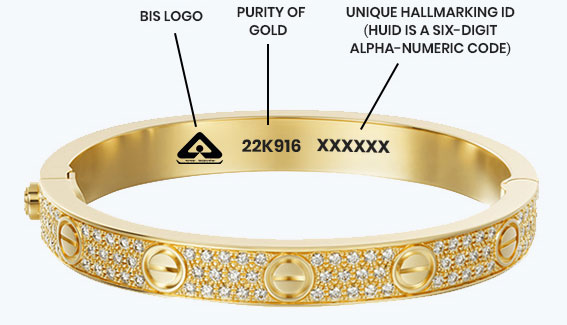
BIS now operates 341 HUID hallmarking centres across 102 Indian districts. Buyers must check the six-digit HUID code via the BIS CARE app before purchasing any gold or silver jewellery in 2026.
As of August 2026, the Bureau of Indian Standards (BIS) operates 341 Assaying and Hallmarking Centres (AHCs) across 102 districts in India, covering more than 25,000 registered silver jewellers — a milestone that reshapes what every diamond and jewellery buyer in India should verify at the point of sale.
This expansion, announced ahead of the 2026 festive season, is not merely administrative. It signals a structural shift in how precious-metal purity is tracked, communicated, and verified in India's jewellery market. For anyone buying a diamond ring set in gold, a silver payal, or any precious-metal article, understanding the HUID system is now as important as understanding carat weight or cut grade.
At a Glance: BIS HUID Hallmarking vs. No Hallmarking vs. Old Hallmarking
The table below captures the three scenarios a buyer might encounter in 2026 — and what each means for traceability, purity assurance, and resale value.
| Feature | BIS HUID Hallmarked (Current System) | Old 5-Mark Hallmark (Pre-2023) | No Hallmark |
|---|---|---|---|
| Purity verification method | 6-digit alphanumeric HUID, verifiable via BIS CARE app | Five physical stamps (BIS logo, purity, AHC mark, jeweller mark, year) | None — buyer relies on jeweller's word |
| Digital traceability | Yes — article linked to AHC, jeweller, and purity grade in BIS database | No digital record | No digital record |
| Legal status (gold) | Mandatory since April 1, 2023 | Phased out; no longer valid for new gold articles | Illegal for covered gold articles |
| Legal status (silver) | Mandatory if hallmarked; hallmarking itself remains voluntary | N/A | Permitted , silver hallmarking is not universally compulsory |
| Consumer verification | Instant via BIS CARE app | Not possible digitally | Not possible |
| Resale confidence | High , purity independently certified | Moderate , physical marks can be forged | Low , no independent certification |
| Fraud resistance | High , unique per article, no duplicates | Lower , marks could be replicated | None |
What exactly is BIS HUID hallmarking, and why does it matter in 2026?
BIS HUID hallmarking is the government-mandated system under which every hallmarked gold or silver article sold in India must carry a Hallmark Unique Identification Number — a six-digit alphanumeric code that is unique to each individual piece and permanently links it to a verified purity record in the BIS database.
The Bureau of Indian Standards (BIS) is India's national standards body, established under the BIS Act, 2016, to promote standards, quality, and conformity assessment across products and services. In the jewellery sector, BIS administers hallmarking standards for precious-metal articles and provides consumers with an independent mechanism to verify purity through its HUID framework and the BIS CARE app.
Before HUID, hallmarking in India used five separate physical stamps — the BIS logo, a purity mark, an Assaying and Hallmarking Centre mark, a jeweller's identification mark, and a year-of-hallmarking mark. While better than nothing, this system had no digital backbone. A consumer could not verify a stamp's authenticity from their phone. Physical marks could be replicated. The chain of accountability ended at the counter.
Since April 1, 2023, six-digit HUID hallmarking has been mandatory for all gold articles sold in India. The silver HUID system followed, with the Silver HUID portal launching on September 1, 2025. As of August 2026, more than 77 lakh silver jewellery pieces have been hallmarked with HUID under the new system — a figure that reflects both growing adoption and the scale of India's silver jewellery market.
For diamond jewellery buyers specifically, this matters because the majority of diamond pieces in India are set in gold. A diamond's cut, colour, and clarity can be assessed through a grading certificate. The purity of the gold or silver setting — which directly affects the piece's intrinsic value and resale price — has historically been harder to verify independently. HUID closes that gap.
What do the marks on a hallmarked gold or silver article actually mean?
Under the current BIS HUID system, a hallmarked gold article carries three components, each serving a distinct purpose.
The BIS Standard Mark is the triangular logo confirming that the article's purity has been validated by a BIS-authorized Assaying and Hallmarking Centre. Its presence on a piece means an accredited laboratory — not just the jeweller — has tested and certified the metal.
The Purity Mark expresses the metal's fineness in two ways: by carat (or grade for silver) and by fineness number. For gold, BIS guidelines effective January 1, 2017 recognise three karat grades: 22 karats (marked 22K916, indicating 91.6% pure gold), 18 karats (18K750), and 14 karats (14K585). For silver, under the revised IS 2112:2025 standard, articles carry the BIS Standard Mark with the word 'SILVER', the purity grade, and the six-digit HUID. The most prevalent silver purity grades in the Indian market are 925 (sterling silver, 92.5% pure) and 800 (80% pure).
The six-digit HUID itself is the critical innovation. No two articles share the same HUID. Scanning or entering this code in the BIS CARE app surfaces the article's purity grade, the AHC that tested it, and the registered jeweller who sold it — what BIS describes as end-to-end traceability, from the testing bench to the buyer's hand.
For buyers of diamond jewellery, a practical check is to verify the HUID on the gold or silver setting of any piece before purchase. A jeweller who cannot produce a HUID-marked article — or who presents a piece with only the old five-stamp system — is either selling pre-2023 stock or operating outside the mandatory framework.
How has the silver hallmarking network expanded, and what does the regional picture look like?
The 341 AHCs now serving 102 districts represent a significant infrastructure build-out since the Silver HUID portal launched in September 2025. The expansion was timed deliberately — BIS announced it ahead of the festive season, when silver demand typically rises, and in a market context where elevated gold prices are pushing some consumers toward silver as an alternative.
The regional distribution of hallmarking volumes is uneven in ways that matter to buyers. The Southern Region accounts for 62% of silver hallmarking volumes nationally, followed by the Western Region at 18% and the Central Region at 10%. This concentration reflects the established strength of organized jewellery retail in South India — states like Tamil Nadu, Kerala, Andhra Pradesh, and Karnataka have long had dense networks of registered jewellers and consumer familiarity with hallmarking.
For buyers in the Northern, Eastern, or North-Eastern regions, this regional skew is worth noting. The density of AHCs and the proportion of hallmarked silver in circulation may be lower in these markets, which makes the BIS CARE app verification step even more important when buying silver there.
The BIS market survey that accompanied the August 2026 announcement provides additional texture on what the silver market actually looks like. Conducted across 345 districts and based on 4,971 responses from 30 States and Union Territories, it found that articles weighing 10–25 grams and 25–50 grams together account for nearly 74% of reported demand. Anklets (payals), chains, toe rings, finger rings, and bracelets were the most commonly sold categories — the everyday silver jewellery that millions of Indian consumers buy without necessarily thinking about hallmarking at all.
Is silver hallmarking mandatory in India, or is it still voluntary?
This is one of the most commonly misunderstood points in the current regulatory space, and the distinction is important.
Silver hallmarking has been voluntary in India since October 2005. There is no universal legal obligation for a jeweller to hallmark silver articles before selling them — unlike gold, where hallmarking became mandatory for registered jewellers in phases from 2021 onward.
HUID marking is, however, mandatory for any silver article that is hallmarked under the revised IS 2112:2025 standard. A jeweller is not legally required to hallmark their silver, but if they choose to hallmark it, they must use the HUID system. They cannot apply the old five-stamp method to new silver articles and call it hallmarked.
This distinction has a practical implication for buyers. When you see a silver article with a HUID, you can be confident that it has been tested by a BIS-accredited AHC and that its purity is independently verified. When you see a silver article without any hallmark, you are relying entirely on the jeweller's representation of purity — which may or may not be accurate.
The current BIS expansion is, as the regulator itself frames it, primarily strengthening the infrastructure and traceability of the voluntary hallmarking space rather than making hallmarking universally compulsory for silver. Whether mandatory silver hallmarking follows — as mandatory gold hallmarking did — remains to be seen, but the infrastructure is being built in anticipation of that possibility.
How does HUID hallmarking affect diamond jewellery buyers specifically?
Diamond jewellery sits at the intersection of two separate quality-assurance frameworks: gemstone grading (for the diamond) and metal hallmarking (for the setting). Most buyers focus heavily on the diamond — its carat weight, cut grade, colour, and clarity, ideally certified by a laboratory like GIA, IGI, or SGL. The metal setting often receives less scrutiny.
HUID hallmarking directly addresses that gap. A lab-grown diamond engagement ring set in 18-karat gold, for example, should carry an 18K750 purity mark and a six-digit HUID on the gold setting. If the ring is sold without a HUID — and the jeweller is registered and selling new stock — that is a red flag worth investigating before purchase.
For buyers considering oval lab-grown diamond solitaire rings or curved solitaire engagement rings in India, the practical checklist at the point of sale should cover both the diamond certificate and the HUID on the metal. A piece that scores well on both dimensions — a certified diamond in a HUID-marked setting — offers the most complete assurance of value.
There is also a resale dimension. When you eventually sell or exchange a diamond jewellery piece, the gold or silver setting's purity is assessed independently by the buyer or their assayer. A HUID-marked setting with a documented purity grade gives you a stronger negotiating position than an unmarked one, because the purity has already been independently certified rather than being subject to dispute at the point of resale.
Branded jewellers like Tanishq have long marketed their internal quality processes as going beyond BIS requirements. As one consumer noted on Quora, Tanishq reportedly runs 35+ checks on a piece before it reaches the customer — though BIS hallmarking remains the legally mandated baseline that all registered jewellers must meet. BIS HUID hallmarking is now the floor, not the ceiling. A jeweller who only meets the BIS minimum is still meeting a meaningful standard; one who exceeds it with additional internal testing is offering something beyond that floor, but the HUID remains the independently verifiable proof point that any consumer can check.
What is the BIS CARE app, and how do you use it to verify a hallmarked article?
The BIS CARE app is the official mobile application through which consumers can verify the details of any HUID-marked gold or silver article by entering or scanning its six-digit alphanumeric code. The app is available on both Android and iOS platforms and is maintained by the Bureau of Indian Standards.
Entering a HUID into the BIS CARE app returns the article's purity grade, the name and location of the Assaying and Hallmarking Centre that tested it, and the registered jeweller's details. This takes seconds and requires no specialist knowledge. It is the single most powerful consumer tool in the current hallmarking framework.
The verification process at the point of sale should follow this sequence. First, locate the HUID on the article — it will be a six-digit alphanumeric code stamped alongside the BIS logo and purity mark. Second, open the BIS CARE app and enter the HUID. Third, confirm that the purity grade shown in the app matches the purity mark on the article and the price you are being charged. Fourth, check that the jeweller's registration details in the app match the shop you are buying from. If any of these checks produce a mismatch, do not complete the purchase without a clear explanation from the jeweller.
BIS is actively advising consumers to purchase hallmarked silver from registered jewellers, verify the HUID through the BIS CARE app, and retain the purchase invoice. The invoice provides a paper record linking the HUID to your specific transaction — useful for insurance, resale, or any future dispute.
What is BIS planning next for the hallmarking infrastructure?
The August 2026 announcement included forward-looking commitments that buyers should be aware of.
BIS has indicated plans to further expand referral and assay laboratories for silver nationally over the next two years, as rising gold prices continue to drive some consumers toward silver. The regulator is also exploring the use of artificial intelligence and robotics to improve testing capacity and turnaround times at AHCs — a signal that the bottleneck in hallmarking adoption is partly operational, and that BIS is treating it as a solvable infrastructure problem rather than a permanent constraint.
For retailers, the BIS framing is explicit: a wider HUID network offers a stronger framework for communicating purity assurance and traceability at the point of sale. Jewellers who invest in HUID compliance — and who train their sales staff to walk customers through the BIS CARE app verification — are positioned to benefit as consumer awareness of the system grows.
The trajectory here mirrors what happened with gold hallmarking. Gold hallmarking began in April 2000 as a voluntary system, became mandatory in phases from 2021, and moved to HUID as the sole valid system from April 2023. Silver hallmarking began as voluntary in October 2005. The current infrastructure expansion, combined with the launch of the Silver HUID portal in September 2025, follows a similar arc. Whether mandatory silver hallmarking follows is a policy decision, but the regulatory direction is not ambiguous.
What should a buyer's checklist look like before purchasing jewellery in India in 2026?
The following checklist applies whether you are buying a diamond ring, a silver payal, or any precious-metal article from a registered jeweller in India.
Confirm the jeweller is BIS-registered. Registered jewellers are listed on the BIS portal. A jeweller who is not registered cannot legally sell hallmarked gold articles and should not be selling new gold jewellery without hallmarking.
Locate the HUID on the article. For gold, this is mandatory on all new articles. For silver, it is mandatory on any article that is hallmarked. The HUID is a six-digit alphanumeric code stamped on the metal itself — not on a tag or certificate that can be swapped.
Verify the HUID via the BIS CARE app. Cross-check the purity grade, AHC details, and jeweller registration. This takes under a minute and costs nothing.
Match the purity mark to the price. A piece marked 22K916 (91.6% gold) should be priced differently from one marked 18K750 (75% gold). Making charges, design premiums, and diamond or gemstone values are separate — but the base metal price should reflect the hallmarked purity.
For diamond jewellery, check both the diamond certificate and the metal HUID. The diamond's quality is certified by its grading report (GIA, IGI, SGL, or equivalent). The metal's purity is certified by the HUID. Both documents should be present and verifiable. If you are buying a lab-grown diamond ring, the diamond itself will carry a lab certificate; the gold or platinum setting should carry a HUID.
Retain the purchase invoice. The invoice links your transaction to the HUID and provides a record for insurance, resale, or any future quality dispute.
For silver, be aware that hallmarking is voluntary but HUID is mandatory if hallmarked. An unhallmarked silver article is not necessarily fraudulent — but it offers no independent purity assurance. If purity matters to you (and for high-value silver purchases, it should), buy hallmarked silver with a HUID and verify it.
Does HUID hallmarking affect the value of lab-grown diamond jewellery differently from mined diamond jewellery?
The short answer is: not differently in any meaningful way. HUID hallmarking certifies the purity of the metal setting — gold, silver, or platinum — regardless of what stone is set in it. A lab-grown diamond and a mined diamond of equivalent quality, set in the same 18-karat gold, should both be in a HUID-marked setting if the jeweller is compliant.
Where the distinction matters is in the overall value calculation. Lab-grown diamonds are physically, chemically, and optically identical to mined diamonds but produced in a controlled laboratory environment rather than extracted from the earth. Their prices have fallen significantly relative to mined diamonds over the past several years, making the metal setting a proportionally larger component of the total piece value in some cases — particularly for smaller stones.
For a lab-grown diamond piece, then, the purity of the gold setting is not a minor footnote. If you are buying a 1.5 to 2 carat oval lab-grown diamond solitaire ring in 18-karat gold, the gold content represents a meaningful share of the piece's intrinsic value. A HUID-verified 18K750 setting is worth more — and more defensible at resale — than an unmarked or improperly marked setting of the same apparent weight.
The same logic applies to silver settings, which are increasingly used in fashion-forward diamond jewellery. With silver hallmarking now covering 341 centres across 102 districts, buyers of silver-set diamond pieces have more access to HUID-verified articles than at any previous point.
What are the most common mistakes buyers make with hallmarking, and how do you avoid them?
The first and most common mistake is treating the presence of any hallmark as sufficient assurance. Articles with old-style five-stamp marks are not fraudulent — but they cannot be verified digitally, and their purity cannot be confirmed through the BIS CARE app. Buying new jewellery in 2026 means you should expect a HUID, not the old stamp system.
The second mistake is not verifying the HUID at the point of sale. Many buyers assume that the presence of a stamp is enough. It is not. Stamps can be applied to articles that have not actually been tested by an AHC. The HUID verification step — which takes under a minute via the BIS CARE app — is the only way to confirm that the stamp corresponds to a real record in the BIS database.
The third mistake is conflating the diamond certificate with the metal hallmark. A GIA or IGI certificate for a diamond tells you nothing about the purity of the gold setting. These are separate quality-assurance systems covering separate components of the same piece. Both matter.
The fourth mistake is not retaining the purchase invoice. Without it, proving the provenance of a piece at resale or for insurance purposes becomes significantly harder.
The fifth mistake — specific to silver — is assuming that unhallmarked silver is necessarily impure. Silver hallmarking is voluntary. An unhallmarked silver article from a reputable jeweller may well be 925 purity. But you have no independent verification of that claim. For high-value silver purchases, the voluntary nature of silver hallmarking means the burden of due diligence falls more heavily on the buyer — which is precisely why the BIS expansion to 341 centres matters.
The BIS HUID expansion to 341 centres across 102 districts is the most significant structural development in India's precious-metal quality-assurance framework since mandatory gold hallmarking was introduced. For buyers of diamond jewellery, silver articles, or any precious-metal piece in India in 2026, the practical implication is straightforward: the tools to verify what you are buying now exist, are free to use, and are available in seconds. Using them is no longer optional for any buyer who cares about the long-term value of their purchase.
Sources
- BIS expands HUID-based silver hallmarking network to 341 centres, 102 districts nationwide - The Retail Jeweller
- Step-by-Step Guide to BIS HUID Gold Hallmarking Registration Online in India
- Many branded jewellers talk about HUID hallmarking and multiple purity checks. How significant are these in practice? - Quora
- BIS Official Website - Bureau of Indian Standards
- 1.5 to 2 Carat Oval Lab-Grown Diamond Solitaire Rings: What to Know Before Buying in India (2026)
- Best Lab-Grown Diamond Engagement Rings to Buy in India (2026)
- Best Curved Solitaire Engagement Rings to Buy in India (2026)