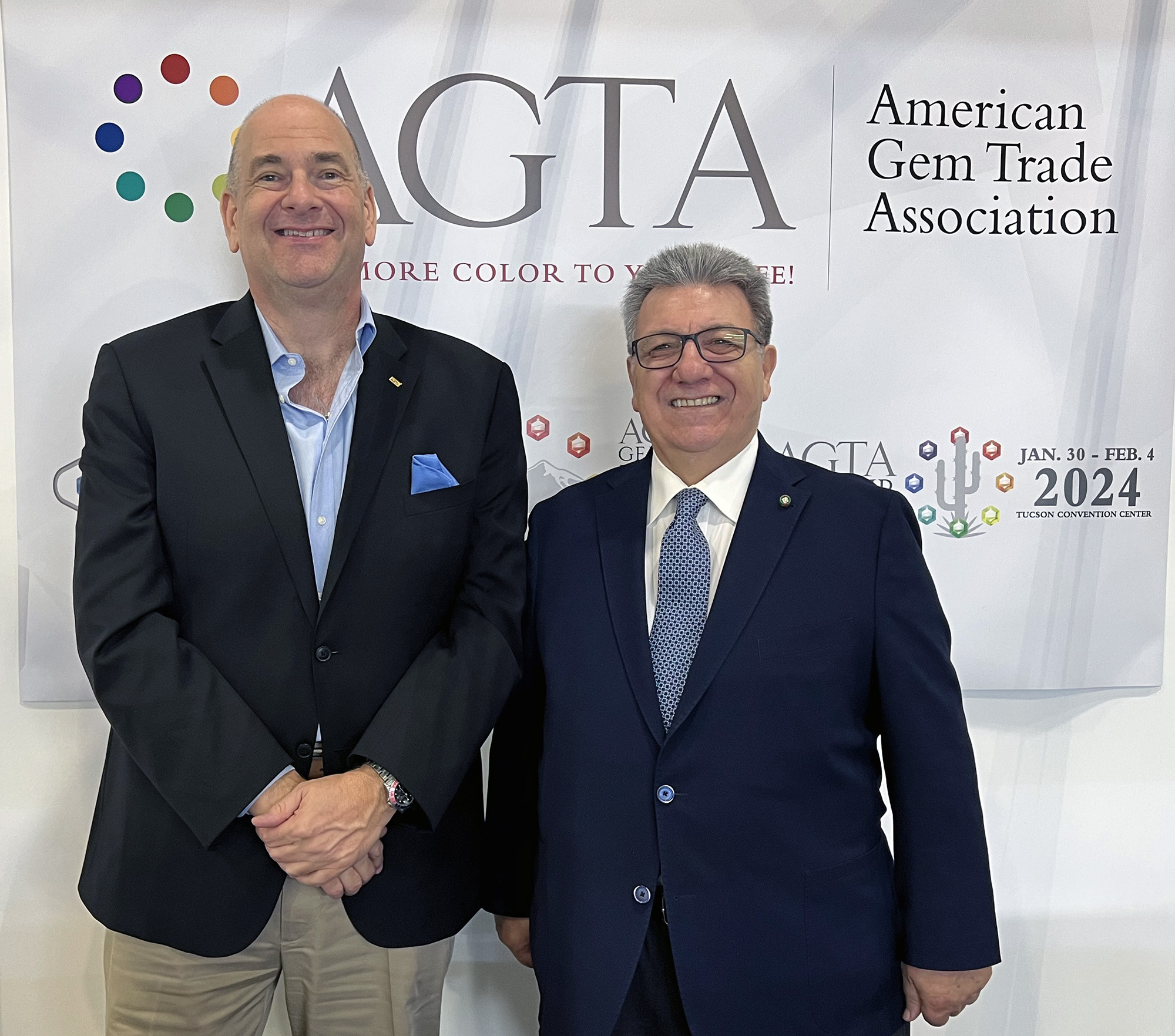
AGTA and CIBJO both mandated "synthetic" over "lab-grown" in 2026, aligning with India's BIS rules — meaning Indian buyers will increasingly see this new terminology on certificates and in stores.
AGTA and CIBJO Now Require 'Synthetic' Instead of 'Lab-Grown': What the Terminology Shift Means for Indian Diamond Buyers in 2026
Two of the world's most influential jewellery trade bodies — the American Gem Trade Association (AGTA) and CIBJO, the World Jewellery Confederation — have independently mandated that man-made diamonds and gemstones must be described as "synthetic" rather than "lab-grown" or "laboratory-created," with both policies taking effect in 2026. India's own Bureau of Indian Standards (BIS) had already moved in the same direction at the start of the year, making this one of the most coordinated global terminology shifts the diamond industry has seen in decades.
For anyone shopping for a lab-grown diamond engagement ring in India, this shift is not merely academic — it will change what appears on grading certificates, how retailers describe their stock, and how consumer protection rules are applied.
| Organisation | Policy | Effective Date | Key Requirement |
|---|---|---|---|
| AGTA (American Gem Trade Association) | Updated Code of Ethics | June 2026 | Members must use "synthetic" for all man-made gems; standalone "lab-grown" barred |
| CIBJO (World Jewellery Confederation) | Diamond Blue Book revision | September 4, 2026 | "Laboratory grown" and "laboratory created" removed; "synthetic" is sole approved term |
| BIS (Bureau of Indian Standards) | Standardised terminology rules | January 2026 | "Diamond" alone reserved for natural stones; "laboratory-grown diamond" required in full for man-made |
| ADPA (African Diamond Producers Association) | Terminology call | May 2026 | Mandated "synthetic" descriptor for lab-grown diamonds |
| Russian Government | Regulatory decree | June 2026 | Lab-grown diamonds in jewellery must be called "synthetic"; weight declared in grams, not carats |
| GIA (Gemological Institute of America) | Terminology update | 2025 | Migrated lab-grown diamond terminology away from natural diamond language |
What exactly did AGTA decide, and why does it matter?
The American Gem Trade Association is the leading US trade body for natural-coloured gemstones and pearls, representing dealers, importers, and manufacturers who set commercial standards across the industry. In June 2026, AGTA's board of directors approved an update to its Code of Ethics requiring members to use "synthetic" for any manufactured material with essentially the same chemical composition, crystal structure, and physical and optical properties as its natural counterpart.
Under the policy, retail jewellers may pair "synthetic" or "man-made" with the gemstone name — "synthetic ruby" or "synthetic diamond," for instance. The standalone use of "lab-grown" as a disclosure term is now barred for AGTA members. AGTA President Bruce Bridges stated that the standard reinforces the association's commitment to natural-coloured gemstones while giving members clear, consistent language.
The terminology change accompanied AGTA's release of the 17th edition of its Gemstone Information Manual, which also adds new enhancement symbols and updated treatment and care guidance. This is not AGTA's first move against lab-grown products — the association banned lab-grown diamonds and gemstones from its trade show floors in 2024, a firm institutional stance that the June 2026 Code of Ethics update now formalises in writing.
What did CIBJO decide, and what is the Blue Book?
CIBJO — the World Jewellery Confederation — is an international non-governmental organisation that sets the global standards published as "Blue Books," which governments, grading laboratories, and trade associations around the world use when developing their own jewellery regulations. Because CIBJO decisions carry significant downstream influence on national policy, its move on terminology is more consequential than any single country's rule change.
At the 2025 CIBJO Congress in Paris, the Diamond Commission — led by president Udi Sheintal — recommended removing "laboratory-grown" and "laboratory-created" as synonyms for "synthetic" in the Diamond Blue Book. The commission argued that the term "laboratory grown" had always been euphemistic and was deliberately intended to impart a sense of scientific mysticism to the product. It further noted that synthetic diamonds are not created in laboratories today but through an industrial manufacturing process — a distinction it considered material to consumer understanding.
Following a year of deliberation that included a joint meeting with CIBJO's own Laboratory Grown Diamond Committee (whose members argued for retaining "laboratory grown" alongside "synthetic"), the Diamond Commission Steering Committee concluded that "synthetic" is unambiguously clear when referring to gemstones. CIBJO announced that from September 2026 — formally at its congress on September 4 — only "synthetic" can be used to describe "artificial products having essentially the same chemical composition, physical properties and structure as that of their naturally occurring counterparts."
Charles Abouchar, head of CIBJO's coloured-stone commission, framed the rationale in terms of consumer protection: "The ultimate goal remains protecting consumer confidence through the adoption of clear and descriptive language that transparently informs. In making this move, it is hoped that the situation in the market will become clearer and the consumer will be properly informed."
As recently as October 2025, CIBJO president Gaetano Cavalieri had told JCK that the group had not yet agreed on what it would do and that the decision process was "very complicated." Moving from open deliberation to a firm policy within roughly nine months reflects how quickly industry consensus shifted in 2026.
How does India's own BIS rule fit into this picture?
India is not a passive observer in this debate. It is one of the world's largest diamond processing and jewellery manufacturing hubs, and its domestic regulatory framework has direct consequences for the millions of Indian consumers who buy diamond jewellery each year.
The Bureau of Indian Standards released its standardised terminology rules in January 2026, establishing that the word "diamond" used alone applies exclusively to natural diamonds. Sellers may use qualifiers like "natural," "real," "genuine," or "precious" alongside "diamond" for mined stones. Man-made alternatives must be explicitly disclosed at all times using only the full terms "laboratory-grown diamond" or "laboratory-created diamond" — shortened abbreviations such as "LGD," "lab-grown," or "lab-diamond" are no longer permitted in formal disclosure under BIS rules.
The BIS standard also forbids using terms like "nature's," "pure," "earth-friendly," or "cultured" for laboratory-grown products, and specifies that using brand names alone without the approved "laboratory-grown" qualifier is insufficient disclosure.
Here is where an important nuance emerges for Indian buyers: the BIS rule, as of January 2026, still requires the full phrase "laboratory-grown diamond" — it does not yet mandate "synthetic." The AGTA and CIBJO decisions go further by eliminating "laboratory-grown" entirely. Whether India's BIS will update its standard to align with CIBJO's September 2026 position remains to be seen, but the trajectory of global policy strongly suggests further convergence. Indian jewellers who export to the US or European markets, or who deal with international grading laboratories, will need to navigate both frameworks simultaneously.
Why did the industry shift away from "lab-grown" in the first place?
The terminology debate has roots that go back decades, but the immediate driver of the 2026 wave of changes is a combination of market dynamics and institutional concern about consumer confusion.
When lab-grown diamonds first entered the mainstream consumer market in the 2010s, the industry — including the Federal Trade Commission in the United States — moved away from "synthetic" on the grounds that consumers associated the word with fake or inferior products like cubic zirconia. In 2018, the FTC removed "synthetic" from its list of recommended descriptors, noting that "the record indicates consumers mistakenly believe 'synthetic' means an artificial product such as cubic zirconia, which lacks a diamond's optical, physical, and chemical properties." Terms like "lab-grown" and "lab-created" were positioned as more consumer-friendly alternatives.
By the mid-2020s, the situation had changed materially. Lab-grown diamond prices had collapsed — stones that sold for thousands of dollars a carat were available for a fraction of that cost — and consumer advocates, natural diamond producers, and trade bodies began arguing that "lab-grown" had become a marketing term rather than a neutral descriptor. The CIBJO Diamond Commission's position was explicit: the term was "deliberately intended to impart a sense of scientific mysticism to the product."
The shift also reflects the industrial reality of how synthetic diamonds are actually made. The two dominant production methods — Chemical Vapour Deposition (CVD) and High Pressure High Temperature (HPHT) — are large-scale manufacturing processes, not laboratory experiments. Describing the output as "lab-grown" was increasingly seen as misleading about the nature of production.
Countries with strong natural diamond interests moved first. France had maintained "synthetic" as its only approved descriptor for two decades. Belgium, in 2023, ruled that synthetic diamonds should be sold by the gram rather than in carats. Russia's government decreed in 2026 that lab-grown diamonds in jewellery must be called "synthetic" and their weight declared in grams. The African Diamond Producers Association made the same call in May 2026. GIA updated its terminology in 2025. By the time AGTA and CIBJO acted in mid-2026, they were consolidating a consensus that had been building for several years.
What does "synthetic" actually mean in this context, and is it accurate?
"Synthetic," as defined by CIBJO's updated Blue Book, applies to artificial products having essentially the same chemical composition, physical properties, and crystal structure as their naturally occurring counterparts. This is a precise scientific definition — not a pejorative one. A synthetic diamond is chemically and physically identical to a mined diamond: both are pure carbon in a cubic crystal lattice, both score 10 on the Mohs hardness scale, both refract light in the same way.
The distinction between "synthetic" and "simulant" matters here. A diamond simulant — such as cubic zirconia or moissanite — is a material that resembles a diamond in appearance but has different chemical composition and physical properties. A synthetic diamond is not a simulant; it is a diamond, produced by a different process. CIBJO's use of "synthetic" preserves this distinction while removing what the confederation considered commercially motivated ambiguity from the term "laboratory-grown."
For Indian buyers, this means that a stone labelled "synthetic diamond" on a certificate or in a jeweller's disclosure is the same material they would previously have seen labelled "lab-grown diamond." The underlying product has not changed, only the approved terminology for describing it.
How will this affect grading certificates and jeweller disclosures in India?
Grading laboratories are the most immediate point of contact between these policy changes and Indian consumers. GIA, which updated its lab-grown diamond terminology in 2025, is the most widely recognised grading body globally and issues large numbers of certificates for stones sold in the Indian market. Other laboratories operating in India — including IGI, which has a significant presence in the Surat and Mumbai markets — will face pressure to align their certificate language with the new CIBJO standard.
For jewellers, the practical implications depend on their market positioning. A retailer selling to export markets — particularly in the US, where AGTA membership carries weight — will need to adopt "synthetic" in their disclosures to remain compliant with AGTA's Code of Ethics. Retailers selling domestically under BIS rules currently need to use the full phrase "laboratory-grown diamond," but should monitor BIS for any updates following the September 2026 CIBJO congress.
Consumers buying from reputable jewellers should not see any change in the physical product — a well-cut, well-graded stone remains exactly that regardless of what the certificate calls it. What will change is the label on the certificate, the language in the sales disclosure, and the marketing materials in store. If you are shopping for a lab-grown diamond solitaire ring in India, asking your jeweller which terminology standard their certificates follow is a reasonable due-diligence question.
Will "synthetic" affect resale value or consumer perception of these diamonds?
This is the question that lab-grown diamond sellers have worried about most. The lab-grown diamond industry has long considered "synthetic" pejorative, arguing that it implies inferiority. CIBJO's Laboratory Grown Diamond Committee representatives made exactly this argument during the joint meeting with the Diamond Commission Steering Committee, contending that over 15 years consumers had come to recognise "laboratory grown" and that reverting to "synthetic" would confuse them further.
The DCSC was unconvinced. The available evidence on resale values suggests the terminology debate may be secondary to the underlying market dynamics — lab-grown diamond prices have already fallen dramatically, driven by oversupply and manufacturing efficiencies rather than by what the stones are called. The CIBJO president himself acknowledged in late 2025 that "when the prices fall, the people who bought the piece at $1,000 and then see the same product is $100 may feel that it is not a good choice."
For Indian buyers, the honest answer is that the shift to "synthetic" is unlikely to materially change resale dynamics that are already being driven by price compression. What it may do is make the distinction between natural and synthetic diamonds clearer to first-time buyers — which is precisely the consumer protection goal that CIBJO, AGTA, and BIS have all cited as their primary motivation.
If you are buying a synthetic diamond primarily for its aesthetic and wearability qualities — which are genuinely identical to a mined diamond — the terminology change should not affect your decision. If you are buying with resale or heirloom value in mind, the durability and daily wear performance of the stone remains unchanged, but the broader market context for synthetic diamond valuations is worth understanding before you buy.
What should Indian buyers do right now?
The practical steps for an Indian buyer navigating this shift are straightforward.
First, understand that the product has not changed. A synthetic diamond — whatever it was called on last year's certificate — is chemically and physically identical to what was previously sold as a "lab-grown diamond." The 4Cs (cut, colour, clarity, carat weight) remain the primary quality determinants, and a well-graded stone from a reputable laboratory is a well-graded stone regardless of the label.
Second, ask your jeweller which terminology standard their certificates and disclosures follow. Reputable jewellers in Delhi, Mumbai, Surat, and other major markets should be aware of both the BIS rules (which currently require "laboratory-grown diamond" in full) and the incoming CIBJO standard (which mandates "synthetic"). If a jeweller is unaware of either, that is itself useful information about their engagement with industry standards. You can find vetted retailers at our guide to lab-grown diamond stores in Delhi.
Third, be aware that abbreviations like "LGD" or "lab-grown" are already non-compliant under BIS rules for formal disclosure. If a jeweller's written invoice or certificate uses these shortened forms, ask for the full approved term. This is not pedantry — it is the basis on which consumer protection claims would be assessed if a dispute arose.
Fourth, watch for BIS updates after September 2026. The CIBJO congress on September 4 will formally adopt the new Blue Book language, and India's standards body has historically aligned with international frameworks. An update to BIS terminology — replacing "laboratory-grown diamond" with "synthetic diamond" — is plausible within the next 12 to 18 months.
Finally, if you are considering a purchase for long-term value, the terminology shift is a useful reminder that the synthetic diamond market is in a period of significant institutional recalibration. The stones themselves are excellent — durable, beautiful, and available at price points that make fine jewellery accessible to a much wider range of buyers. The market context is evolving rapidly, though, and staying informed about how the industry describes and regulates these products is part of being a confident buyer. Our guide to the best men's diamond solitaire rings in India and our overview of U-prong and six-prong solitaire settings can help you focus on the product qualities that matter most, whatever the certificate says on the cover.
The broader picture: a global convergence on "synthetic"
The speed with which the global jewellery industry has moved toward "synthetic" in 2026 is striking. Within a single calendar year, BIS (January), ADPA (May), AGTA (June), Russia (June), and CIBJO (September) have all moved in the same direction. GIA had already begun the shift in 2025. The FTC's 2018 position — which removed "synthetic" from recommended descriptors — now looks increasingly isolated, and there is active lobbying in the United States to revisit it.
Whether this convergence will ultimately benefit or harm the synthetic diamond market depends on factors well beyond terminology. The stones' physical properties are not in dispute. Their price trajectory has been driven by manufacturing economics, not by what they are called. Consumer demand for affordable, ethically transparent diamond alternatives remains real and growing, particularly among younger buyers in India who are entering the fine jewellery market for the first time.
What the terminology shift does achieve is clarity — the kind that allows a buyer to make an informed comparison between a natural diamond and a synthetic one, understanding that they are choosing between two genuinely different products with different supply chains, different price dynamics, and different cultural associations. That is a reasonable outcome for consumers, even if it is a contested one for the industry.
For Indian buyers in 2026, the message is simple: the stone in the jeweller's case is the same stone it was before June. What is changing is the language the industry uses to describe it — and understanding that language is the first step to buying with confidence.
Sources
- AGTA Bars 'Lab-Grown' Label, Mandates 'Synthetic' for Man-Made Gems
- CIBJO Expects to Nix 'Lab-Grown' Terminology
- CIBJO Congress 2026 – Diamonds Special Report
- CIBJO Mulls Whether to Call Lab-Grown Diamonds 'Synthetic'
- India Announces Change to Diamond Nomenclature (PriceScope Community)
- AGTA Official Website
- CIBJO Official Website